
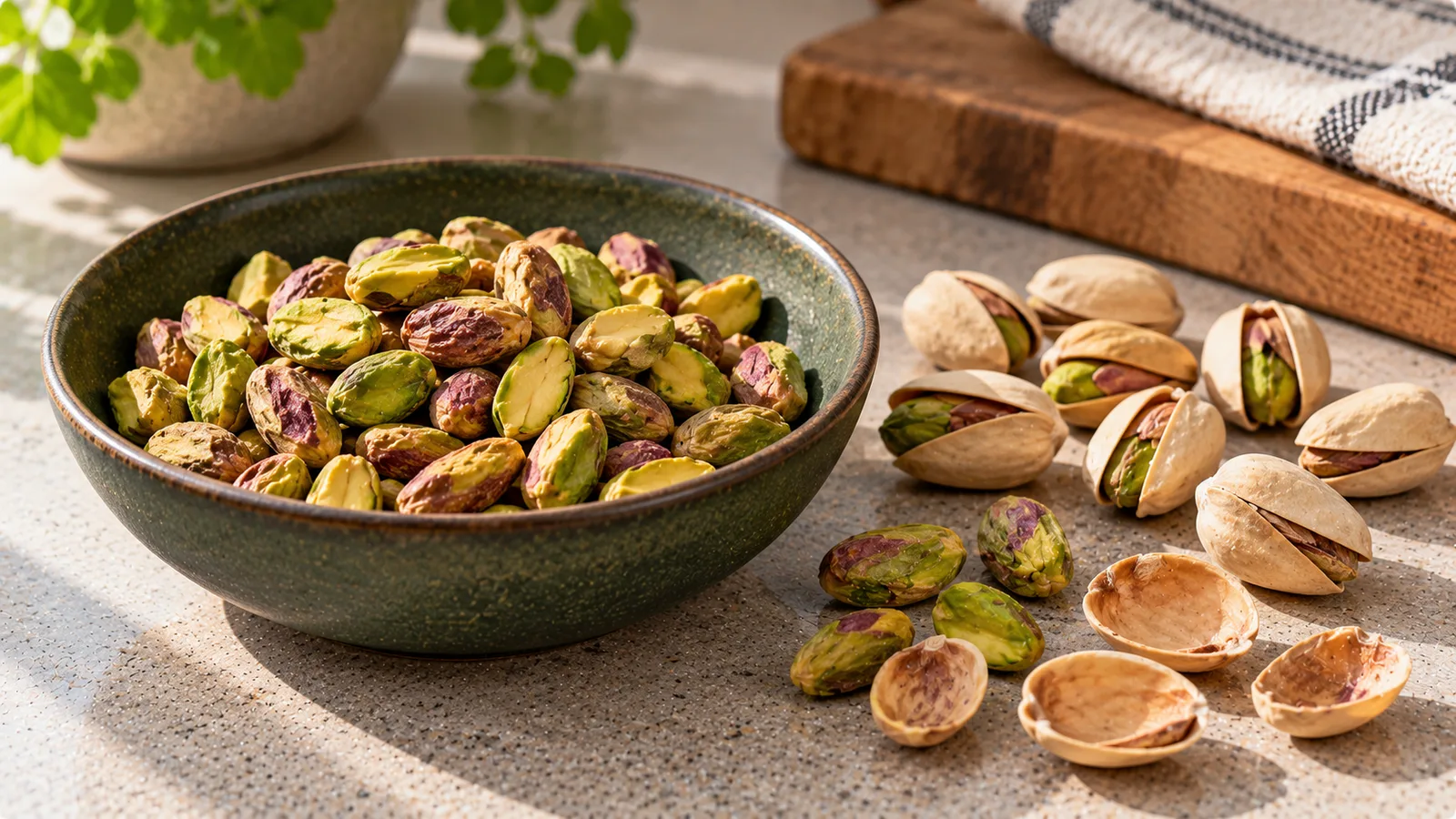
Pistachios are a popular snack, but their calorie content can be difficult to estimate when they are eaten directly from the shell.
A handful may look small, yet pistachios are energy-dense because they contain substantial amounts of fat. They also provide protein, fibre and several micronutrients.
The most important distinction when calculating calories is whether the weight includes the shells.
As a practical reference, 100 g of edible pistachio kernels provide approximately 560 kcal. A 30 g portion contains about 168 kcal.
These figures are rounded estimates based on commonly reported food-composition values. Actual nutrition varies by product, preparation and analytical data.
For ingredient-level information, consult USDA FoodData Central.
Pistachio calories by weight
The following table refers to the edible kernels, without shells.
| Edible pistachios | Approximate calories |
|---|---|
| 5 g | 28 kcal |
| 10 g | 56 kcal |
| 15 g | 84 kcal |
| 20 g | 112 kcal |
| 25 g | 140 kcal |
| 28 g | 157 kcal |
| 30 g | 168 kcal |
| 40 g | 224 kcal |
| 50 g | 280 kcal |
| 75 g | 420 kcal |
| 100 g | 560 kcal |
The calculation uses an illustrative reference of 560 kcal per 100 g.
For example:
30 × 560 / 100 = 168 kcal.
The table is intended for practical portion estimation, not as an exact laboratory result for every pistachio product.
If your package lists a different energy value, use the manufacturer's declaration.
Nutrition facts per 100 grams
Pistachios contain a mixture of fat, protein, carbohydrates and dietary fibre.
Approximate values for plain edible pistachio kernels are:
| Nutrient | Per 100 g |
|---|---|
| Energy | 560 kcal |
| Protein | 20 g |
| Total fat | 45 g |
| Carbohydrates | 27 g |
| Dietary fibre | 10 g |
These are rounded reference figures, not a universal label specification.
Carbohydrate declarations also require care when comparing regions. US nutrition data may include fibre within total carbohydrates, whereas EU labels generally present carbohydrate and fibre separately.
Therefore, the carbohydrate number in one database may not match the figure printed on a European package even when the underlying food is similar.
Use USDA FoodData Central for food-composition records and the EU Food Information Regulation for the European labelling framework.
What does a 30 g serving provide?
A 30 g portion of edible kernels provides approximately:
| Nutrient | Approximate amount |
|---|---|
| Calories | 168 kcal |
| Protein | 6 g |
| Fat | 13.5 g |
| Carbohydrates | 8.1 g |
| Fibre | 3 g |
These numbers are calculated from the rounded 100 g reference values.
They are useful for understanding the scale of a portion, but a product label may report slightly different figures.
For example, a flavoured pistachio snack may include added oil, sugar or seasoning.
The safest approach is to use the nutrition information for the product you actually eat.
How many pistachios are in one serving?
Pistachios are often described by the number of nuts rather than by weight.
A commonly used rough estimate is that approximately 49 kernels make up a one-ounce serving of about 28 g.
However, kernel sizes vary.
A count of 20 large kernels may weigh more than 20 small ones.
The number is therefore useful as a visual guide, but not as a precise measurement.
For food tracking, weighing the edible portion is more reliable than counting shells.
Pistachios with shells versus without shells
This is one of the biggest sources of error when recording pistachios.
Suppose you weigh 50 g of in-shell pistachios.
That does not mean you eat 50 g of kernels.
Part of the weight belongs to the discarded shells.
The edible proportion depends on the product and the size of the shells.
For a rough illustration, imagine that 50 g of in-shell pistachios yields 25 g of kernels.
Using the 560 kcal per 100 g reference:
25 × 560 / 100 = 140 kcal.
If you incorrectly recorded all 50 g as edible kernels, the estimate would be 280 kcal.
That is twice the illustrative amount actually eaten.
The example uses an assumed edible yield, not a fixed conversion factor for all pistachios.
For the most accurate result, weigh the kernels after removing the shells.
How to measure an in-shell portion accurately
A practical method requires only a kitchen scale.
- Weigh the pistachios before eating.
- Keep the empty shells.
- Weigh the shells afterward.
- Subtract the shell weight from the original weight.
- Record the estimated edible weight.
For example:
Initial weight: 70 g.
Discarded shells: 34 g.
Estimated edible portion: 36 g.
Estimated calories:
36 × 560 / 100 = 202 kcal, rounded.
This approach is especially useful when pistachios are eaten from a shared bowl or large package.
It assumes the measured shell weight represents the discarded non-edible material and that nothing significant was lost or added during handling.
Are roasted pistachios higher in calories?
Roasting changes moisture content and may change the nutritional values expressed per 100 g.
Dry-roasted pistachios and raw pistachios can therefore have slightly different energy values by weight.
Oil-roasted pistachios may contain additional fat, depending on the preparation.
However, not every roasted product has a large calorie difference.
The exact result depends on processing and the finished product.
Compare the label of the specific raw, dry-roasted or oil-roasted pistachios rather than assuming that all roasted nuts contain the same calories.
A nutrition database such as USDA FoodData Central can help distinguish preparation types.
Do salted pistachios have more calories?
Salt itself does not add meaningful calories.
If the only difference is added salt, the calorie content may remain similar.
However, some flavoured pistachio products also contain oil, sugar, starches or coatings.
Those additions can change the nutritional profile.
Salted products can also contain substantially more sodium than unsalted alternatives.
Check the ingredients and nutrition declaration.
A label describing pistachios as salted does not tell you everything about how they were prepared.
Pistachios and protein
Pistachios provide approximately 20 g protein per 100 g in the rounded reference used here.
That makes them a source of plant protein.
However, their energy content matters when considering them as a primary protein source.
A 30 g portion provides about 6 g protein and 168 kcal.
For comparison, someone trying to obtain a large amount of protein from pistachios alone would also consume a considerable amount of energy.
Pistachios are therefore often more practical as one component of a meal than as its sole protein source.
They can be combined with yogurt, oats, fruit, salads or other foods according to dietary preferences.
Fat in pistachios
Most of the calories in pistachios come from fat.
That does not automatically make them an unsuitable food.
Dietary fat is an important part of normal nutrition, and pistachios contain a mixture of fatty acids.
However, the high fat content explains why even modest portions contribute meaningful calories.
For someone tracking energy intake, the useful strategy is to measure portions rather than exclude pistachios entirely.
A 15 g topping and a 60 g snack are very different in energy contribution.
The portion size is usually more important for calorie tracking than whether the food is described as healthy.
Fibre and other nutrients
Pistachios contribute dietary fibre and contain micronutrients such as vitamin B6, potassium and copper.
Their exact amounts vary with the food-composition record and serving size.
A 30 g serving provides approximately 3 g fibre using the rounded reference in this article.
Pistachios can therefore contribute to dietary variety.
They should not be treated as a replacement for vegetables, fruit, legumes or other fibre-containing foods.
For detailed micronutrient values, use USDA FoodData Central and compare the relevant food entry.
Pistachios during weight loss
Pistachios can fit into an eating pattern intended for weight management.
The important question is how the portion fits into total energy intake and the rest of the diet.
For example, a 20 g portion provides approximately 112 kcal.
A 60 g portion provides approximately 336 kcal.
Both can be reasonable in different contexts, but they are not interchangeable when tracking calories.
Eating pistachios from the shell may encourage a slower eating pace for some people because each nut requires an extra action.
That does not guarantee lower calorie intake.
If you need a predictable amount, measure the portion before eating.
Example: pistachios in a breakfast bowl
Consider a breakfast containing:
- 200 g plain yogurt.
- 100 g berries.
- 30 g oats.
- 15 g pistachio kernels.
The pistachios alone contribute approximately:
15 × 560 / 100 = 84 kcal.
The total breakfast calories depend on the type of yogurt, berries and oats used.
Full-fat and low-fat yogurts can differ considerably.
To estimate the whole meal, use the actual product labels or reliable food-composition entries for every ingredient.
Do not assign the same nutritional value to every yogurt product.
Example: pistachios as a salad topping
Pistachios can add crunch to salads.
Suppose a salad contains vegetables, cooked grains, a protein source and 20 g pistachio kernels.
The pistachios contribute approximately 112 kcal.
If the salad also contains oil-based dressing, that should be recorded separately.
The presence of nuts does not mean the dressing's calories can be ignored.
Similarly, a salad described as light can contain substantial energy if several calorie-dense toppings are added.
The goal is an accurate description of the meal, not avoidance of any particular ingredient.
Pistachio butter and pistachio paste
Pistachio butter and paste are not necessarily nutritionally identical to plain kernels.
Some products contain only ground pistachios.
Others include sugar, vegetable oils, milk ingredients or additional flavourings.
A sweet pistachio spread can therefore differ substantially from pure pistachio paste.
Check the ingredient list and nutrition values per 100 g.
Do not use the plain-pistachio calorie value for a sweetened spread unless the product information supports that estimate.
Common tracking mistakes
Recording the weight of the shells
This overestimates the edible portion.
Record the kernels, not the discarded shells.
Confusing grams with the number of nuts
Kernel size varies.
Use weight for more consistent estimates.
Treating all pistachio products as identical
Raw, roasted, salted, coated and sweetened products can have different nutritional values.
Ignoring small toppings
A few grams may seem unimportant, but several toppings can add up across a meal.
Using a generic database entry when a label is available
A specific product declaration is usually the better choice for that product.
Mixing up carbohydrate definitions
US and EU carbohydrate reporting conventions can differ.
Compare like with like.
Are pistachios suitable for people with nut allergies?
Pistachios are tree nuts and can trigger serious allergic reactions in susceptible people.
They are not a safe substitute for someone with a relevant tree-nut allergy unless a qualified clinician has confirmed suitability.
Products may also carry information about other allergens or potential cross-contact.
Always check the packaging.
EU rules require declaration of specified allergens, including relevant tree nuts, under Regulation (EU) No 1169/2011.
The European Commission's food-information guidance provides further regulatory context.
How to log pistachios in a nutrition app
For the most accurate entry:
- Identify whether the pistachios are raw, roasted or flavoured.
- Check whether the package's nutrition values refer to the edible product.
- Weigh kernels without shells.
- Enter the actual edible grams.
- Use the product's nutrition declaration when available.
- Record added oils or coatings if the database entry does not include them.
If you eat pistachios from a large in-shell bag, measuring the shell waste can improve the estimate.
For small amounts used as toppings, weighing before adding them to the dish is usually easiest.
What matters most
Pistachios provide approximately 560 kcal per 100 g of edible kernels using the rounded reference in this guide.
That means about 168 kcal for 30 g and 112 kcal for 20 g.
They also contribute protein, fat, fibre and micronutrients.
The biggest practical issue is not whether pistachios are nutritious. It is measuring the portion correctly, particularly when shells are included.
Use the edible weight, check the actual product label and treat database values as estimates rather than exact measurements.