
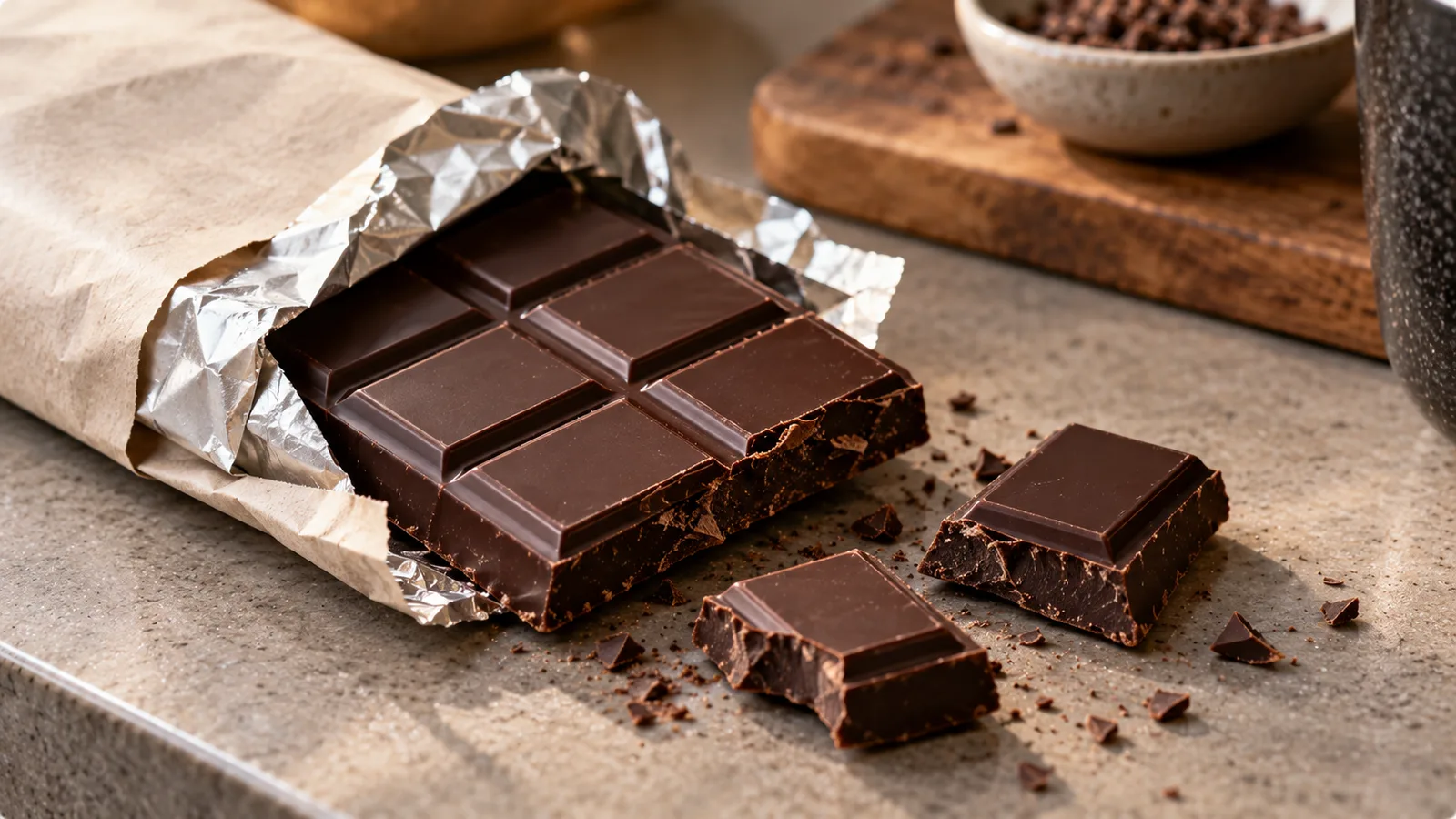
Dark chocolate is energy-dense, so even a small piece can contribute a noticeable number of calories.
As a practical estimate, 100 g of dark chocolate contains around 550–650 kcal, depending on the recipe and cocoa percentage. A useful midpoint for everyday calculations is 600 kcal per 100 g.
That means a 20 g serving provides approximately 120 kcal.
These are rounded reference estimates, not guaranteed values for every chocolate bar. For an exact figure, use the nutrition declaration on your product.
Dark chocolate calories by serving size
The following table uses an illustrative value of 600 kcal per 100 g, equivalent to 6 kcal per gram.
| Dark chocolate portion | Estimated calories |
|---|---|
| 5 g | 30 kcal |
| 10 g | 60 kcal |
| 15 g | 90 kcal |
| 20 g | 120 kcal |
| 25 g | 150 kcal |
| 30 g | 180 kcal |
| 40 g | 240 kcal |
| 50 g | 300 kcal |
| 75 g | 450 kcal |
| 100 g | 600 kcal |
For example, if your chocolate contains 580 kcal per 100 g, a 30 g portion contains 174 kcal rather than 180 kcal.
The underlying reference values can be checked against food composition data in USDA FoodData Central.
Nutrition per 100 g
Dark chocolate usually provides a substantial amount of fat and carbohydrates, with smaller amounts of protein and fiber.
A representative illustration for a dark chocolate product is:
| Nutrient | Approximate amount per 100 g |
|---|---|
| Energy | 600 kcal |
| Protein | 8 g |
| Total fat | 43 g |
| Saturated fat | 25 g |
| Carbohydrates | 46 g |
| Sugars | 24 g |
| Fiber | 11 g |
This is an illustrative nutritional profile, not a universal composition.
Different products may have substantially different sugar, fat and fiber contents. The nutrition labels on the package take priority over these example values.
The USDA FoodData Central database provides food-composition records that can be used as references, while EU Regulation 1169/2011 governs nutrition information for prepacked foods sold in the EU.
How many calories are in one square?
There is no universal weight for a square of dark chocolate.
Some bars are divided into small 5 g pieces, while others have larger segments.
Using 600 kcal per 100 g:
| Weight of one square | Estimated calories |
|---|---|
| 5 g | 30 kcal |
| 7 g | 42 kcal |
| 10 g | 60 kcal |
| 12.5 g | 75 kcal |
| 15 g | 90 kcal |
| 20 g | 120 kcal |
The most reliable method is to divide the bar's total weight by the number of equal-sized squares.
For example, a 100 g bar divided into ten equal pieces has approximately 10 g per piece.
If the same bar contains 600 kcal per 100 g, one piece contains approximately 60 kcal.
Does 70%, 85% or 90% dark chocolate have more calories?
A higher cocoa percentage does not automatically mean fewer calories.
Dark chocolate contains cocoa solids, cocoa butter and often sugar. The balance between these ingredients changes with the recipe.
As cocoa percentage increases, sugar content often decreases, but fat content may increase.
Because fat provides more energy per gram than carbohydrate, a lower-sugar chocolate can still have a similar or higher calorie density.
Consider these fictional label examples:
| Cocoa percentage | Calories per 100 g | Calories per 20 g |
|---|---|---|
| 60% | 560 kcal | 112 kcal |
| 70% | 580 kcal | 116 kcal |
| 85% | 610 kcal | 122 kcal |
| 90% | 620 kcal | 124 kcal |
These numbers illustrate how products might differ. They are not averages for all chocolates with these cocoa percentages.
The actual package label is more useful than cocoa percentage alone.
European chocolate product definitions are covered by Directive 2000/36/EC.
How to calculate calories accurately
Use this formula:
Calories eaten = calories per 100 g × portion weight ÷ 100.
Example: a dark chocolate bar contains 592 kcal per 100 g.
For 25 g:
592 × 25 ÷ 100 = 148 kcal.
For 35 g:
592 × 35 ÷ 100 = 207.2 kcal.
For 50 g:
592 × 50 ÷ 100 = 296 kcal.
This method works for any brand as long as you use the correct nutrition label and the actual weight eaten.
Calories in dark chocolate compared with milk chocolate
Dark and milk chocolate differ in their ingredients and proportions of cocoa, sugar, milk ingredients and fat.
However, calorie values frequently overlap.
A dark chocolate product is not automatically lower in calories than milk chocolate.
The meaningful comparison is between two specific labels.
| What to compare | Why |
|---|---|
| Calories per 100 g | Direct energy comparison |
| Sugars per 100 g | Shows differences in sugar content |
| Saturated fat per 100 g | Helps evaluate fat composition |
| Fiber per 100 g | May differ with cocoa content |
| Portion weight | Determines actual intake |
If one bar has 550 kcal per 100 g and another has 620 kcal per 100 g, a 20 g portion differs by only 14 kcal.
The larger difference may come from how much chocolate you eat.
Does dark chocolate contain protein?
Yes, dark chocolate contains some protein, but it is not generally an efficient protein source.
Using the illustrative profile above:
- 10 g contains approximately 0.8 g protein.
- 20 g contains approximately 1.6 g protein.
- 30 g contains approximately 2.4 g protein.
- 100 g contains approximately 8 g protein.
The same 100 g portion also contains approximately 600 kcal.
For someone specifically trying to increase protein intake, foods such as yogurt, legumes, eggs or tofu may be more practical depending on dietary preferences.
Dark chocolate is better treated as a food chosen for taste and enjoyment rather than as a primary protein source.
Fiber in dark chocolate
Cocoa ingredients can contribute dietary fiber.
However, the amount varies with cocoa content and manufacturing.
Using the illustrative value of 11 g fiber per 100 g:
| Portion | Estimated fiber |
|---|---|
| 10 g | 1.1 g |
| 20 g | 2.2 g |
| 30 g | 3.3 g |
| 50 g | 5.5 g |
These values should not be applied automatically to every dark chocolate product.
Use the package label when fiber is declared or a suitable composition database such as USDA FoodData Central.
What about cocoa flavanols?
Cocoa contains naturally occurring compounds known as flavanols.
Their quantity depends on the cocoa ingredients and processing methods.
The European Food Safety Authority evaluated a specific health claim concerning cocoa flavanols and normal endothelium-dependent vasodilation.
That assessment does not mean every dark chocolate bar provides a clinically meaningful benefit.
Cocoa percentage alone does not reveal the amount of cocoa flavanols in the finished product.
It is therefore inappropriate to assume that a higher percentage automatically means a stronger health effect.
Caffeine in dark chocolate
Dark chocolate can contain caffeine and theobromine.
The amounts vary between products and with cocoa composition.
If you are sensitive to caffeine or eat chocolate late in the day, this may matter.
The FDA's caffeine guidance explains that individual sensitivity varies.
During pregnancy, caffeine intake from all sources should be considered together. The NHS pregnancy guidance provides practical advice on caffeine consumption.
For precise caffeine amounts in a specific chocolate, manufacturer information or an appropriate laboratory-based food database is preferable to assumptions based on cocoa percentage.
Is dark chocolate suitable for weight management?
Dark chocolate can fit into a balanced eating pattern, including when someone is managing calorie intake.
The important variables are portion size, total daily energy intake and overall dietary quality.
For example:
- A 10 g piece at 600 kcal per 100 g contributes about 60 kcal.
- A 20 g portion contributes about 120 kcal.
- A 50 g portion contributes about 300 kcal.
None of these portions is automatically right or wrong.
If you enjoy dark chocolate, measuring a portion can make its energy contribution easier to understand without eliminating the food entirely.
How to measure a portion without a scale
If you do not have a kitchen scale, use the bar's packaging.
Suppose a 100 g bar contains eight equal pieces.
One piece weighs approximately:
100 ÷ 8 = 12.5 g.
At 600 kcal per 100 g, each piece provides approximately:
600 × 12.5 ÷ 100 = 75 kcal.
Two pieces provide approximately 150 kcal.
This approach assumes that all pieces are equal in weight.
If the bar has irregular pieces, the estimate becomes less accurate.
Dark chocolate in common snacks
Dark chocolate is often eaten with other foods.
Consider these fictional combinations:
| Snack | Example calories |
|---|---|
| 20 g dark chocolate | 120 kcal |
| 20 g dark chocolate + 100 g strawberries | Approximately 152 kcal |
| 20 g dark chocolate + 15 g almonds | Approximately 207 kcal |
| 10 g dark chocolate + 150 g plain yogurt | Depends on yogurt; approximately 150 kcal in one illustrative combination |
These are examples, not universal nutrition values.
For reliable logging, calculate each ingredient from its actual quantity and nutrition data.
A practical serving guide
| Goal | Practical approach |
|---|---|
| Small taste after a meal | Start with a 5–10 g piece |
| Measured dessert portion | Weigh 15–25 g |
| Sharing a bar | Divide by actual weight, not visual size |
| Comparing brands | Use calories per 100 g |
| Tracking intake | Record grams eaten |
| Choosing lower sugar | Compare sugars per 100 g, not cocoa percentage alone |
The best serving size depends on your preferences and the rest of your diet.
The key numbers
For a convenient estimate, remember:
10 g dark chocolate ≈ 60 kcal.
20 g ≈ 120 kcal.
30 g ≈ 180 kcal.
100 g ≈ 600 kcal.
These estimates are useful for quick calculations, but your product's nutrition label provides the better answer.
Dark chocolate is not automatically lower in calories because it contains more cocoa. The actual weight eaten and calories per 100 g determine the energy in your serving.