
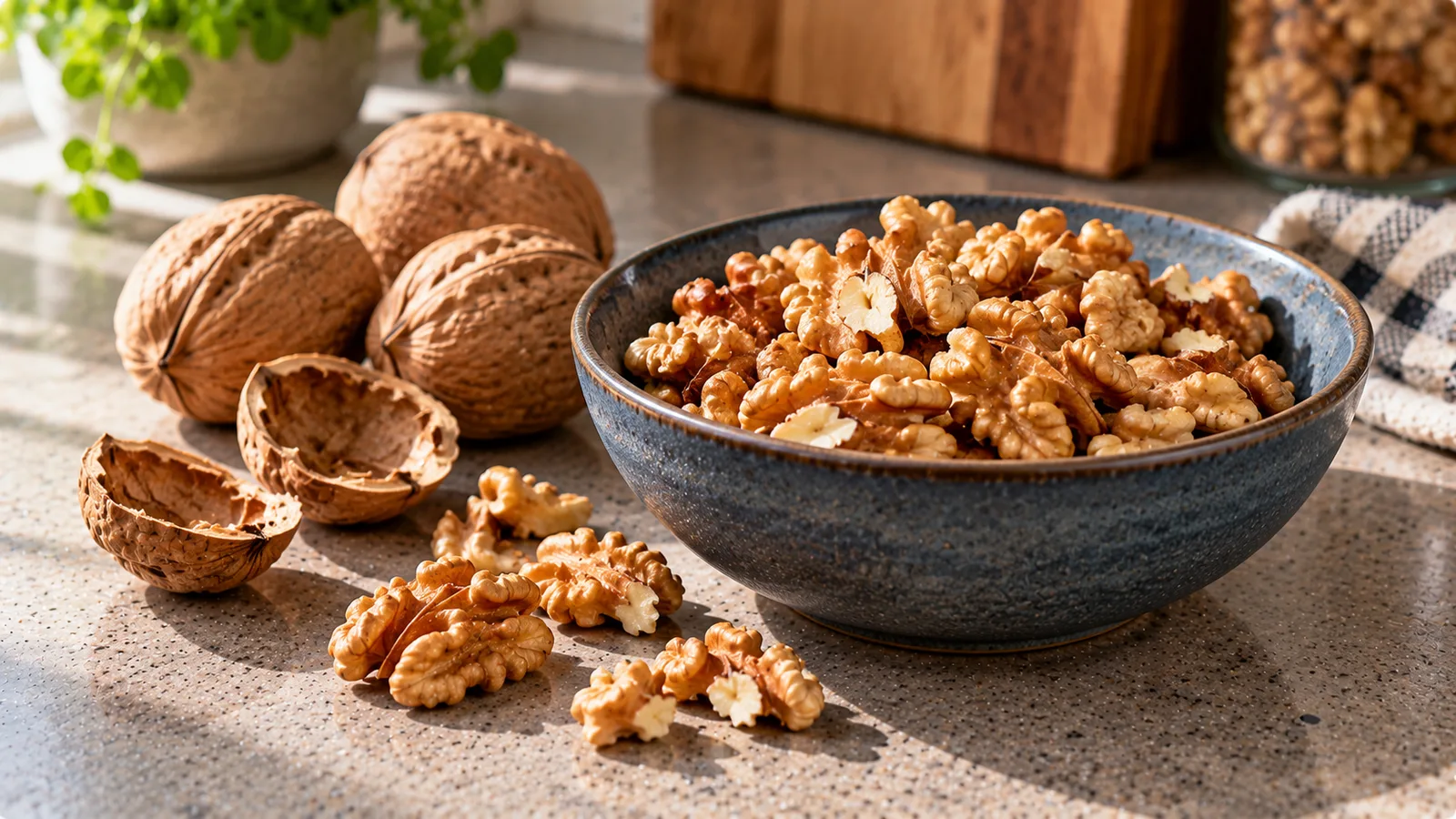
Walnuts are energy-dense because most of their calories come from fat. A small handful can add substantial energy to a meal, even though walnuts also provide protein, fibre and unsaturated fatty acids.
For accurate calorie tracking, the most important detail is the weight of the edible walnut kernels, not the number of shells or the size of the handful.
How many calories are in walnuts?
A commonly used food-composition reference for raw English walnuts is approximately 654 kcal per 100 g of edible kernels.
Using that reference value:
| Walnut kernels | Approximate calories |
|---|---|
| 5 g | 33 kcal |
| 10 g | 65 kcal |
| 15 g | 98 kcal |
| 20 g | 131 kcal |
| 25 g | 164 kcal |
| 28 g | 183 kcal |
| 30 g | 196 kcal |
| 40 g | 262 kcal |
| 50 g | 327 kcal |
| 75 g | 491 kcal |
| 100 g | 654 kcal |
These figures are calculated from a reference composition and rounded. They are not measurements of every walnut variety or brand.
Food-composition values can be checked against USDA FoodData Central and its reference entry for walnuts.
Walnut nutrition per 100 g
Raw walnuts contain substantial amounts of fat, with smaller contributions from protein and carbohydrate.
| Nutrient | Approximate amount per 100 g |
|---|---|
| Energy | 654 kcal |
| Protein | 15.2 g |
| Total fat | 65.2 g |
| Saturated fat | 6.1 g |
| Carbohydrate | 13.7 g |
| Total sugars | 2.6 g |
| Fibre | 6.7 g |
| Alpha-linolenic acid (ALA) | 9.1 g |
The figures are rounded reference values for raw English walnuts. The carbohydrate figure follows the US total-carbohydrate convention, which includes fibre; EU labels generally declare carbohydrate differently.
ALA is a plant-derived omega-3 fatty acid. The NIH Office of Dietary Supplements explains its dietary role and how it differs from the marine omega-3 fatty acids EPA and DHA.
Nutrition in a 30 g portion
A 30 g serving is a convenient amount to weigh when using walnuts as a snack or topping.
| Nutrient | Approximately 30 g |
|---|---|
| Calories | 196 kcal |
| Protein | 4.6 g |
| Fat | 19.6 g |
| Saturated fat | 1.8 g |
| Total carbohydrate, US definition | 4.1 g |
| Fibre | 2.0 g |
| ALA omega-3 | 2.7 g |
The portion provides useful nutrients, but it is not a particularly high-protein food relative to its calorie content.
If your goal is to increase protein intake, walnuts can complement other foods rather than replace a dedicated protein source.
How to calculate walnut calories by weight
Use this simple calculation:
Walnut calories = kernel weight in grams × 6.54.
For example, if you add 18 g of walnuts to oatmeal:
18 × 6.54 = 117.7 kcal, or approximately 118 kcal.
For 35 g:
35 × 6.54 = 228.9 kcal, or approximately 229 kcal.
This method is more reliable than guessing the calories in a handful.
For a packaged product, the nutrition label should be your first reference because the product-specific value may differ.
How many walnuts make 30 g?
A commonly used household estimate is that roughly 14 walnut halves provide about 28 g of kernels.
That means approximately 15 halves may be close to 30 g.
However, halves vary in size, and some pieces are broken.
Use the count only as a rough visual guide.
A kitchen scale gives a more accurate answer.
Walnuts with shells versus walnut kernels
Calorie values in nutrition databases generally refer to the edible portion.
If you weigh whole walnuts with shells, the scale includes material you will not eat.
For example, 60 g of walnuts in shells does not mean you consumed 60 g of kernels.
The edible yield varies with shell thickness, variety and the individual nuts.
For tracking, either weigh the kernels after shelling or use a reliable product-specific edible-yield estimate.
Do not multiply the weight of whole unshelled walnuts by 6.54.
Raw versus roasted walnuts
Dry roasting mainly changes moisture, flavour and texture.
The calorie content per 100 g may change slightly when water content changes, even without adding oil.
Oil-roasted walnuts may contain additional fat depending on preparation.
Sweetened or coated walnuts can contain additional sugar and other ingredients.
| Product | What to check |
|---|---|
| Raw walnut kernels | Standard kernel weight and nutrition |
| Dry-roasted walnuts | Product-specific energy per 100 g |
| Oil-roasted walnuts | Added oil and declared energy |
| Candied walnuts | Added sugars and coating |
| Walnut butter | Ingredients and serving weight |
| Walnuts in baked goods | Entire recipe, not just walnuts |
A label comparison is more dependable than assuming all walnut products have identical calories.
Are walnuts mostly fat?
Yes.
Fat makes up roughly two-thirds of the weight of raw walnuts.
Much of this fat is unsaturated.
That helps explain why walnuts are energy-dense even though they contain relatively little sugar.
High fat content does not automatically make a food unsuitable for a balanced diet.
The quantity eaten and the overall dietary pattern matter.
The World Health Organization's healthy diet guidance discusses dietary fat quality and the role of unsaturated fats.
Omega-3 in walnuts: what it means
Walnuts are notable among commonly eaten nuts for their ALA content.
ALA is an essential omega-3 fatty acid.
However, ALA is not identical to EPA or DHA, which are found primarily in certain marine foods and supplements.
The body can convert some ALA into longer-chain omega-3 fatty acids, but conversion is limited and variable.
For that reason, a walnut portion should not be described as nutritionally equivalent to a serving of oily fish.
See the NIH omega-3 fact sheet for details on the different omega-3 forms.
Are walnuts a good protein source?
Walnuts contain about 15 g of protein per 100 g.
That sounds substantial, but 100 g also contains approximately 654 kcal.
A more realistic 20 g topping provides about 3 g of protein and 131 kcal.
For comparison, protein-focused foods such as skyr, lentils, eggs or tofu can contribute different amounts of protein per calorie.
Walnuts are best viewed as a source of unsaturated fats and other nutrients that also provides some protein.
They do not need to be judged solely by their protein content.
Fibre and carbohydrate
Walnuts provide fibre, but they are not as fibre-rich per calorie as many legumes, vegetables or whole grains.
A 30 g portion contains approximately 2 g of fibre.
When comparing carbohydrate figures, pay attention to labeling conventions.
USDA total carbohydrate includes dietary fibre.
EU nutrition labels generally list available carbohydrate separately, while fibre may be declared on another line.
This can make two apparently similar entries look different even when they describe the same food.
The EU Food Information to Consumers Regulation defines the relevant labeling framework.
Calories in walnuts compared with other foods
Consider a bowl of plain yogurt with fruit.
Adding 10 g of walnuts contributes about 65 kcal.
Adding 30 g contributes about 196 kcal.
Adding 50 g contributes about 327 kcal.
The difference between the smallest and largest topping is approximately 262 kcal.
This does not make the larger serving inherently wrong.
It shows why toppings should be weighed when precise calorie tracking matters.
Walnut portion examples for everyday meals
| Meal or snack | Walnut amount | Walnut calories |
|---|---|---|
| Oatmeal topping | 10 g | 65 kcal |
| Yogurt with fruit | 15 g | 98 kcal |
| Salad topping | 20 g | 131 kcal |
| Small snack | 25 g | 164 kcal |
| Larger snack portion | 30 g | 196 kcal |
| Baking ingredient | 40 g | 262 kcal |
These values describe the walnuts alone, not the complete meal.
If you add walnuts to a recipe, include the other ingredients when calculating total calories.
How walnuts affect a recipe's calories
Suppose you make four servings of apple and oat breakfast bake.
You add 40 g of chopped walnuts to the whole dish.
Walnut calories:
40 × 6.54 = 261.6 kcal.
Additional calories per serving:
261.6 ÷ 4 = 65.4 kcal.
Each serving gains approximately 65 kcal from the walnuts.
The same principle applies to salads, muffins, porridge and homemade granola.
Can walnuts fit into a weight-loss diet?
Yes.
A food's calorie density does not determine whether it can fit into a weight-management plan.
What matters is how its portion contributes to total energy intake and the overall quality of the diet.
For example, 15 g of walnuts can add flavour and texture to a bowl of yogurt without contributing the calories of a 50 g serving.
Walnuts can also replace another ingredient rather than always being added on top.
If you are tracking energy intake, measure the portion and account for it consistently.
Avoid treating walnuts as either a forbidden food or a food whose calories do not count.
Why packaged walnut calories may differ
Food-composition databases contain averages or representative samples.
Individual packages can vary because of:
- Walnut variety.
- Moisture content.
- Processing.
- Added ingredients.
- Rounding rules.
- Different analytical or calculation methods.
A label showing 680 kcal per 100 g is not necessarily incorrect simply because a database reference gives 654 kcal.
For the exact product you eat, use the declared values when available.
The EU labeling regulation establishes the general rules for nutrition declarations.
A quick label-reading example
Imagine a walnut package declares:
| Per 100 g | Label value |
|---|---|
| Energy | 680 kcal |
| Fat | 68 g |
| Protein | 14 g |
| Carbohydrate | 7 g |
| Fibre | 6 g |
These figures are hypothetical.
For a 25 g portion:
680 × 0.25 = 170 kcal.
In this situation, use 170 kcal for the specific product rather than the generic 164 kcal estimate.
The difference is small, but the method matters when you track many foods over time.
Walnuts and vitamin E
Walnuts contain some vitamin E, but they should not automatically be treated as the richest source of this nutrient.
Different nuts and seeds vary substantially in vitamin E content.
For example, almonds and sunflower seeds are commonly recognized as concentrated dietary sources.
The NIH vitamin E fact sheet provides reference information on dietary sources.
If vitamin E is your main nutritional goal, compare foods using actual composition data rather than assuming all nuts are equivalent.
Food allergies and practical safety
Walnuts are tree nuts and can trigger serious allergic reactions in susceptible people.
People with a diagnosed walnut or tree-nut allergy should follow their medical guidance and check labels for relevant allergens and cross-contact information.
Under EU food information rules, walnuts fall within the tree-nut allergen category requiring appropriate declaration.
Store walnuts in a cool, dry place in suitable packaging.
Because they contain substantial unsaturated fat, their flavour and quality can deteriorate during poor storage.
Discard walnuts that show mould, an unusual odour or obvious spoilage.
The most useful numbers to remember
For raw walnut kernels, a practical reference is:
- 100 g: approximately 654 kcal.
- 30 g: approximately 196 kcal.
- 20 g: approximately 131 kcal.
- 10 g: approximately 65 kcal.
Use edible kernel weight, check the label for packaged products and include walnuts when calculating recipe calories.
That is enough to track walnuts accurately without making portion control unnecessarily complicated.