
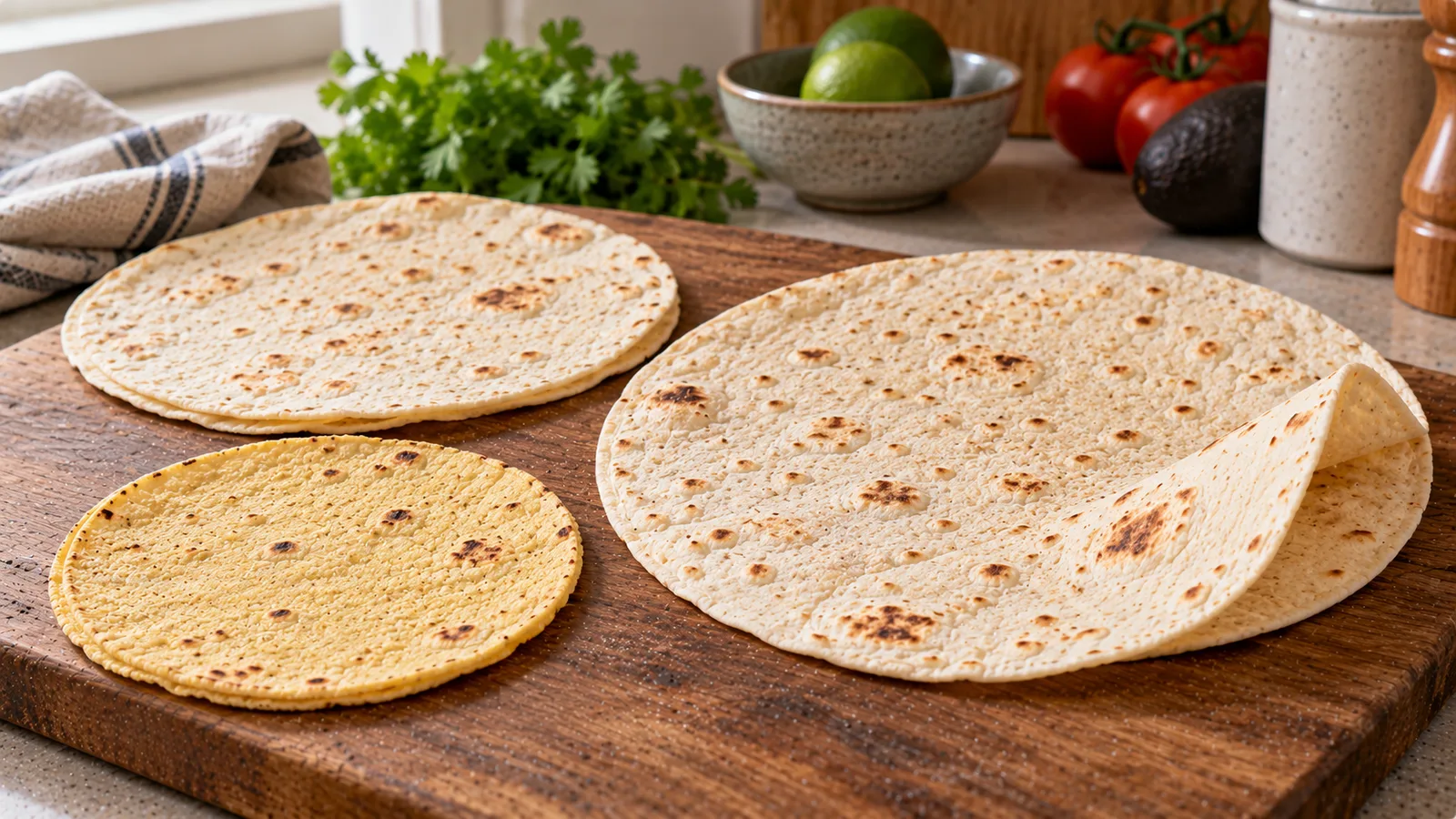
A tortilla can contain fewer than 60 calories or more than 250 calories, depending on its ingredients, weight and diameter.
That wide range explains why counting tortillas by the piece can be misleading.
A small corn tortilla for a taco is very different from a large flour tortilla used for a restaurant-style burrito.
The most reliable way to calculate tortilla calories is to use the product's nutrition information per 100 g and the weight of the tortilla you actually eat.
How many calories are in a tortilla?
Here are practical estimates for common plain tortillas.
| Tortilla type | Typical weight | Estimated calories |
|---|---|---|
| Small corn tortilla | 25 g | 50–60 kcal |
| Medium corn tortilla | 30 g | 60–70 kcal |
| Small flour tortilla | 30 g | 85–100 kcal |
| Medium flour tortilla | 45 g | 125–150 kcal |
| Large flour tortilla | 65 g | 180–215 kcal |
| Extra-large flour tortilla | 90 g | 250–300 kcal |
| Whole-wheat tortilla | 50 g | 130–165 kcal |
These figures are estimates, not standardized serving sizes.
Brands differ in flour composition, added oil, moisture and thickness.
Some tortillas marketed as large or high-protein have significantly different calorie values.
For accurate tracking, use the actual package label.
Tortilla calories per 100 grams
Comparing calories per 100 g removes the effect of different serving sizes.
| Type | Illustrative energy per 100 g |
|---|---|
| Traditional corn tortilla | 200–230 kcal |
| Regular wheat-flour tortilla | 280–330 kcal |
| Whole-wheat tortilla | 260–330 kcal |
| Reduced-calorie tortilla | Varies substantially by formulation |
Corn tortillas often have fewer calories per 100 g than flour tortillas, but that is not a universal rule.
Flour tortillas commonly contain added fat, which can increase energy density.
Corn tortillas are frequently made with nixtamalized corn, water and sometimes salt.
The recipe and water content determine the final value.
Example: calories in a 60 g flour tortilla
Suppose the label states 310 kcal per 100 g.
The calculation is:
60 × 310 ÷ 100 = 186 kcal.
If the same tortilla weighs 75 g:
75 × 310 ÷ 100 = 232.5 kcal.
This difference comes entirely from portion weight.
Flour tortillas versus corn tortillas
Flour and corn tortillas differ in more than calories.
Flour tortillas
Wheat-flour tortillas are typically flexible and well suited to wraps, burritos and quesadillas.
Common ingredients include wheat flour, water, fat, salt and raising agents.
Their calorie density depends partly on how much oil or shortening is included.
A large tortilla can contribute a substantial amount of energy before any filling is added.
Corn tortillas
Traditional corn tortillas are generally smaller and are commonly used for tacos.
They may contain less fat than standard flour tortillas.
Their carbohydrate and fiber content depends on the corn flour, preparation method and brand.
Traditional corn tortillas made entirely from corn-based ingredients may be gluten-free, but cross-contact and added ingredients must be checked when gluten avoidance is medically necessary.
Which has fewer calories?
For comparable weights, a plain traditional corn tortilla is often lower in calories.
However, the actual difference depends on the products.
A 30 g flour tortilla can contain fewer total calories than a 60 g corn tortilla simply because it is smaller.
Always distinguish calories per 100 g from calories per piece.
Nutrition: carbohydrates, protein, fat and fiber
The following values illustrate possible differences between plain commercial products.
They should not be treated as exact nutrition data for every tortilla.
| Nutrient per 100 g | Corn tortilla | Flour tortilla |
|---|---|---|
| Energy | ~218 kcal | ~312 kcal |
| Protein | ~5.7 g | ~8.3 g |
| Total fat | ~2.9 g | ~8.3 g |
| Total carbohydrate, US convention | ~44.6 g | ~52.1 g |
| Fiber | ~6.3 g | ~3.3 g |
The figures are rounded reference examples. Formulations vary.
An important labeling distinction: US total carbohydrate values generally include fiber, while EU carbohydrate declarations exclude fiber and list it separately.
This means values imported from US and European databases may not be directly comparable without checking their definitions.
For a packaged tortilla sold in Europe, prioritize the EU nutrition declaration on the package.
Calories by tortilla diameter
Diameter is useful for estimating portions, but it does not determine calories by itself.
Two tortillas with the same diameter can differ considerably in thickness and weight.
| Approximate diameter | Common use | Illustrative weight |
|---|---|---|
| 10–13 cm | Small taco | 20–30 g |
| 15–18 cm | Taco or small wrap | 30–45 g |
| 20–23 cm | Medium wrap | 45–65 g |
| 25–30 cm | Large wrap or burrito | 65–100 g |
A thin 25 cm tortilla may weigh less than a thick 20 cm tortilla.
If you have a kitchen scale, weight is more useful than diameter.
How many calories are in two tortillas?
The calculation is straightforward when you know the weight.
Imagine two corn tortillas weighing 28 g each, with a label value of 220 kcal per 100 g.
Combined weight:
28 × 2 = 56 g.
Calories:
56 × 220 ÷ 100 = 123.2 kcal.
Now imagine two flour tortillas weighing 55 g each at 305 kcal per 100 g.
Combined weight:
55 × 2 = 110 g.
Calories:
110 × 305 ÷ 100 = 335.5 kcal.
Both meals contain two tortillas, but the energy contribution is very different.
Tortilla calories in popular meals
A tortilla is usually only one component of the final meal.
Chicken wrap
Example ingredients:
| Ingredient | Amount | Approximate calories |
|---|---|---|
| Flour tortilla | 60 g | 186 kcal |
| Cooked chicken breast | 100 g | 165 kcal |
| Lettuce and tomato | 100 g | 20 kcal |
| Yogurt sauce | 40 g | 35 kcal |
| Total | 406 kcal |
This is an illustrative calculation.
Actual calories depend on cooking oil, sauce ingredients and product labels.
Two bean tacos
| Ingredient | Amount | Approximate calories |
|---|---|---|
| Corn tortillas | 2 × 28 g | 123 kcal |
| Cooked black beans | 120 g | 158 kcal |
| Salsa | 60 g | 20 kcal |
| Avocado | 40 g | 64 kcal |
| Total | 365 kcal |
The toppings and fillings can contribute more energy than the tortillas themselves.
Cheese quesadilla
A quesadilla made with two medium flour tortillas and cheese can be considerably more calorie-dense.
For example:
- Two tortillas, 50 g each, at 310 kcal per 100 g: 310 kcal.
- Cheddar, 60 g, at approximately 400 kcal per 100 g: 240 kcal.
- Oil, 5 g: approximately 45 kcal.
Estimated total: 595 kcal.
Using one tortilla folded in half instead of two can substantially change the calculation.
Are whole-wheat tortillas lower in calories?
Not necessarily.
Whole-wheat tortillas may provide more fiber than comparable refined-wheat versions, but they are not automatically lower in energy.
A manufacturer may add oil or other ingredients to achieve the desired texture.
Some whole-wheat tortillas contain similar or even higher calories per 100 g than standard flour tortillas.
If your priority is fiber, compare fiber per 100 g.
If your priority is energy intake, compare calories and the weight of the actual portion.
Both measures can matter.
What about low-carb and high-protein tortillas?
Specialty tortillas can differ considerably from traditional products.
A low-carb tortilla may use added fiber, modified starches or alternative flours.
A high-protein tortilla may include wheat gluten, soy protein, pea protein or other concentrated protein ingredients.
Check:
- Calories per tortilla and per 100 g.
- Actual tortilla weight.
- Protein and fiber content.
- Fat and saturated fat.
- Salt.
- Allergens.
- The definition of carbohydrate used by the label.
A marketing claim such as low-carb does not guarantee low calories.
Similarly, high-protein does not automatically mean nutritionally superior for every person.
How to log tortilla calories accurately
For food tracking, use this sequence.
- Identify the specific product.
- Read the nutrition label per 100 g.
- Check the number of tortillas in the package.
- Find the net package weight.
- Calculate the average weight per tortilla, or weigh one directly.
- Multiply the weight by the calories per gram.
- Record fillings, sauces and cooking oil separately.
Example using package weight
A package contains eight tortillas and weighs 480 g.
Average weight per tortilla:
480 ÷ 8 = 60 g.
The label states 295 kcal per 100 g.
One tortilla:
60 × 295 ÷ 100 = 177 kcal.
Two tortillas:
177 × 2 = 354 kcal.
If the tortillas are not uniform, weighing them individually is more precise.
Common mistakes when counting tortilla calories
Using a generic value per piece
A database entry may describe a 25 g tortilla while your tortilla weighs 75 g.
That can lead to a large underestimate.
Confusing dry flour with finished tortillas
The nutrition of dry wheat or corn flour is not the same as the nutrition of a finished tortilla.
Water, fat and cooking affect the final weight and energy density.
Forgetting oil
Heating a tortilla in a dry skillet adds no cooking oil.
Frying it in oil can increase the total calories.
Ignoring fillings
Cheese, mayonnaise, avocado and oily sauces can contribute substantial energy.
Assuming corn always means gluten-free
Traditional corn tortillas can be made without gluten-containing ingredients, but some commercial products contain wheat or may be affected by cross-contact.
Read the label when gluten avoidance is necessary.
Are tortillas good for weight management?
Tortillas can fit into a calorie-controlled eating pattern.
The relevant factors include portion size, total meal composition, satiety and overall energy intake.
A smaller tortilla with a substantial filling of beans, vegetables and protein may be more satisfying than a large tortilla with little filling.
There is no need to avoid tortillas solely because they contain carbohydrates.
Choose the type and portion that fit your nutritional needs and preferences.
Frequently asked questions
How many calories are in one flour tortilla?
A small 30 g flour tortilla may contain approximately 85–100 kcal. A large 65–90 g tortilla can contain roughly 180–300 kcal, depending on its recipe.
How many calories are in one corn tortilla?
A traditional 25–30 g corn tortilla commonly contains around 50–70 kcal.
Are corn tortillas healthier than flour tortillas?
Neither is automatically healthier in every situation. Corn tortillas often contain less fat, while specific whole-wheat products may offer more fiber. Compare the complete nutrition information and portion sizes.
Do tortillas contain gluten?
Wheat-flour tortillas contain gluten. Traditional corn tortillas may be gluten-free, but ingredients and cross-contact must be checked.
Do tortillas have fewer calories than bread?
That depends on the weight and recipe. A large flour tortilla can contain as many or more calories than several slices of bread.
How many calories are in a tortilla wrap?
The tortilla alone may contribute approximately 100–300 kcal. The complete wrap depends on its filling, sauces and cooking method.
Sources and reference data
- USDA FoodData Central — reference food composition data for tortillas and ingredients.
- European Commission: Food Information to Consumers — EU nutrition labeling rules.
- USDA MyPlate — general guidance on grains and balanced meals.
Key takeaway
A tortilla's calories depend primarily on its weight and recipe, not simply whether it is made from flour or corn.
For a quick estimate, small corn tortillas often contain around 50–70 kcal, while larger flour tortillas can contain 180–300 kcal or more.
For accurate nutrition tracking, calculate from the actual product label and include the ingredients added to the tortilla.