
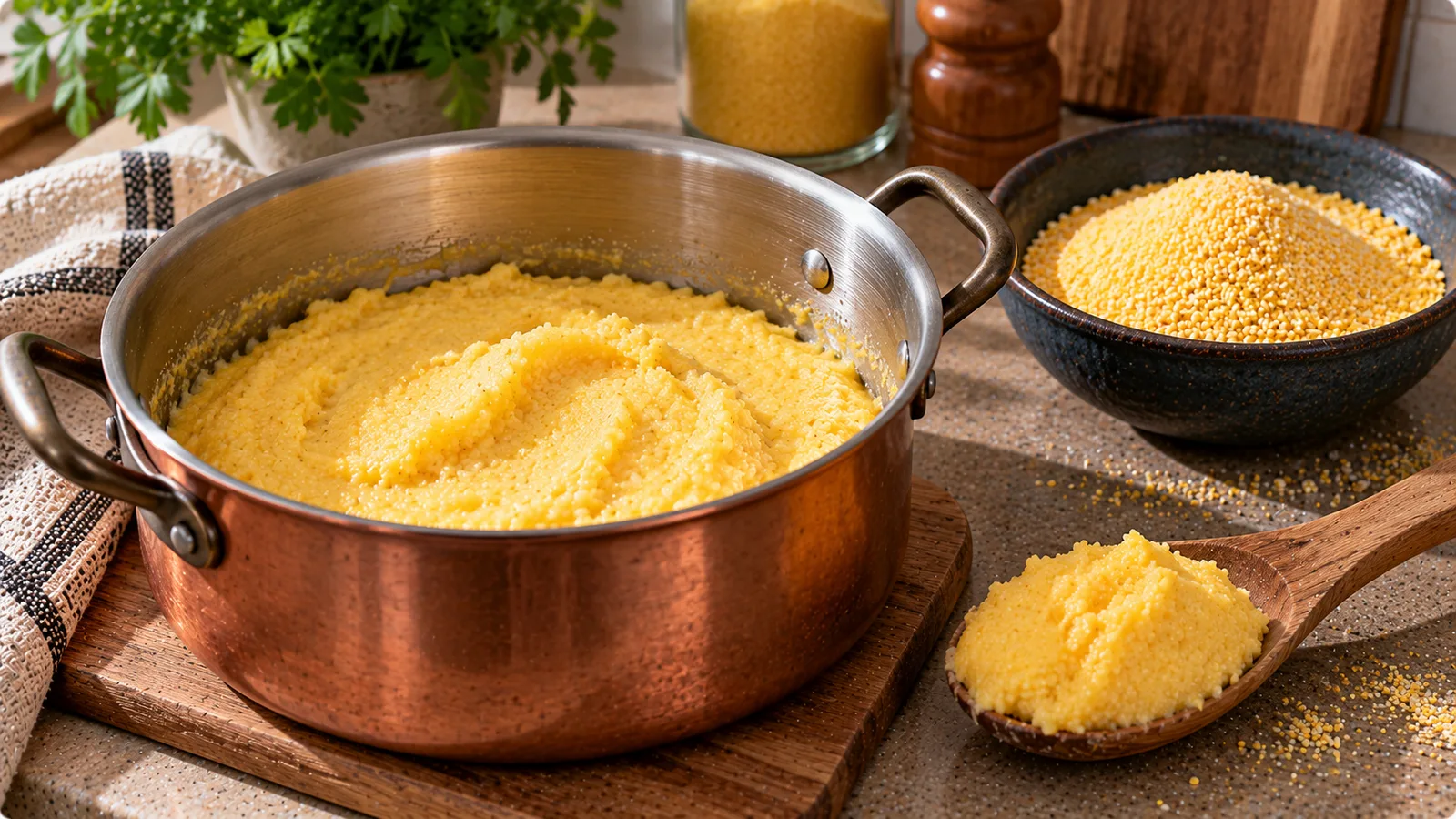
Polenta is a dish made by cooking ground corn in water, stock or milk. It can be served soft and creamy, allowed to set into firm slices, or baked and grilled.
Its calorie content depends heavily on whether you measure the cornmeal before cooking or the finished polenta afterward.
As a practical reference, 100 g of dry cornmeal used for polenta contains approximately 360–370 kcal. Plain polenta cooked with water often provides around 70–100 kcal per 100 g, although the actual value varies with the amount of water used.
Polenta prepared with butter, cheese, milk or oil can contain considerably more calories.
The most reliable way to track polenta is to weigh the dry cornmeal and calculate the finished recipe.
Polenta calories at a glance
The following examples use 365 kcal per 100 g dry cornmeal and 85 kcal per 100 g for an illustrative plain cooked polenta.
| Quantity | Approximate calories |
|---|---|
| 25 g dry polenta | 91 kcal |
| 40 g dry polenta | 146 kcal |
| 50 g dry polenta | 183 kcal |
| 60 g dry polenta | 219 kcal |
| 75 g dry polenta | 274 kcal |
| 100 g dry polenta | 365 kcal |
| 100 g cooked plain polenta | 85 kcal |
| 150 g cooked plain polenta | 128 kcal |
| 200 g cooked plain polenta | 170 kcal |
| 250 g cooked plain polenta | 213 kcal |
The cooked figures are examples, not universal food composition values.
A thick polenta made with less water can contain more calories per 100 g than a soft, loose polenta.
Always check the product label or the specific food database entry.
Dry versus cooked polenta: nutrition comparison
Dry polenta is essentially cornmeal, although the grain size and processing can differ.
Cooked polenta contains substantially more water.
| Nutrient | Dry cornmeal, 100 g | Plain cooked polenta, illustrative 100 g |
|---|---|---|
| Calories | ~365 kcal | ~85 kcal |
| Protein | ~7–9 g | ~1.5–2 g |
| Fat | ~1–4 g | ~0.2–1 g |
| Total carbohydrate | ~75–80 g | ~18–20 g |
| Fiber | ~3–7 g | Depends on cornmeal and dilution |
| Water | Low | High |
The cooked column represents a water-based preparation with a typical dilution, not a separate guaranteed laboratory analysis.
Different brands of cornmeal may contain different amounts of fat and fiber.
In addition, US food databases often include dietary fiber in total carbohydrate, whereas EU nutrition labels report carbohydrates excluding fiber.
These conventions can make two otherwise similar entries look inconsistent.
Why cooked polenta has fewer calories per 100 g
When dry cornmeal is cooked, it absorbs water.
Water increases the weight but contributes no calories.
For example, suppose you use 80 g of dry polenta:
80 × 365 ÷ 100 = 292 kcal.
If you cook it with water and the final dish weighs 320 g, the energy density is:
292 ÷ 320 × 100 = approximately 91 kcal per 100 g.
If you add more water and the finished polenta weighs 400 g:
292 ÷ 400 × 100 = approximately 73 kcal per 100 g.
Both batches contain the same 292 kcal from the cornmeal.
The difference is the amount of water in each 100 g portion.
This is why a cooked-polenta entry should never be treated as an exact conversion for every recipe.
How much does polenta weigh after cooking?
Polenta can be prepared with different ratios of dry cornmeal to liquid.
A common starting point for soft polenta is approximately one part dry cornmeal to four or five parts liquid by weight, although recipes vary.
Some water evaporates during cooking.
The final weight therefore depends on the recipe, simmering time and desired consistency.
| Dry cornmeal | Example finished weight | Calories from cornmeal | Calories per 100 g |
|---|---|---|---|
| 40 g | 180 g | 146 kcal | 81 kcal |
| 50 g | 225 g | 183 kcal | 81 kcal |
| 60 g | 270 g | 219 kcal | 81 kcal |
| 80 g | 320 g | 292 kcal | 91 kcal |
| 100 g | 400 g | 365 kcal | 91 kcal |
These are illustrative calculations using different cooking yields.
They are not promises about how much cooked polenta a given dry weight will produce.
Weighing the finished batch is more accurate than assuming a fixed multiplier.
How to calculate polenta calories accurately
Step 1: Weigh the dry cornmeal
Suppose you use 200 g of dry polenta.
At 365 kcal per 100 g:
200 × 3.65 = 730 kcal.
Step 2: Count any calorie-containing ingredients
Water and salt do not contribute meaningful calories.
Milk, butter, oil, cheese and cream do.
For example, adding 20 g butter contributes roughly 145 kcal, depending on the product.
The total recipe energy becomes approximately 875 kcal before considering any other additions.
Step 3: Weigh the cooked batch
Suppose the finished polenta weighs 900 g.
Step 4: Calculate calories per 100 g
875 ÷ 900 × 100 = approximately 97 kcal per 100 g.
Step 5: Calculate your serving
A 250 g serving contains:
250 × 97 ÷ 100 = approximately 243 kcal.
The result reflects your own recipe rather than an assumed generic cooked value.
How many calories are in a serving of polenta?
Serving size depends on whether polenta is a side dish or the main carbohydrate component of a meal.
| Dry cornmeal used | Approximate calories |
|---|---|
| 30 g | 110 kcal |
| 40 g | 146 kcal |
| 50 g | 183 kcal |
| 60 g | 219 kcal |
| 75 g | 274 kcal |
| 100 g | 365 kcal |
These amounts refer to the dry cornmeal alone.
They do not include butter, cheese, milk, sauces or other ingredients.
A moderate portion of polenta with vegetables and beans may have a different total energy content from the same polenta topped with butter and parmesan.
Creamy polenta with butter and cheese
Many restaurant-style polenta recipes contain substantial amounts of dairy or fat.
Consider a batch made with:
- 150 g dry cornmeal: approximately 548 kcal.
- 25 g butter: approximately 180 kcal.
- 50 g parmesan: approximately 200 kcal.
- Water and salt: negligible calories.
The total is approximately 928 kcal.
If divided into four equal servings, each contains approximately 232 kcal before adding a sauce or protein.
The cooked weight affects calories per 100 g, but not the total calories of the batch.
The exact energy depends on the ingredient brands and quantities.
Is polenta high in carbohydrates?
Polenta is made from corn, so most of its dry energy comes from carbohydrates.
Dry cornmeal commonly contains around 75–80 g of total carbohydrate per 100 g under US-style food database conventions.
The amount per 100 g cooked is much lower because water makes up a large share of the final weight.
Cooking does not remove most of the carbohydrate from the original cornmeal.
If you manage carbohydrate intake, measuring the dry quantity or calculating your actual recipe is more dependable than relying on a generic cooked value.
For EU labels, remember that carbohydrate values generally exclude fiber.
How much protein does polenta provide?
Polenta contains some protein, but it is not usually a concentrated protein source.
Depending on the product, 100 g dry cornmeal may contain approximately 7–9 g protein.
A 50 g dry serving therefore provides roughly 3.5–4.5 g protein.
To build a more protein-rich meal, serve polenta with:
- Lentils or beans.
- Tofu or tempeh.
- Eggs.
- Fish or chicken.
- A suitable dairy or soy-based topping.
Adding cheese can increase protein, but also raises fat, sodium and calories.
Is polenta gluten-free?
Plain polenta made entirely from corn is naturally gluten-free.
However, some packaged products may contain additional ingredients or be exposed to gluten-containing grains during processing.
People with celiac disease should choose appropriately labeled gluten-free products and verify ingredient information.
Do not assume that every instant polenta mix, seasoned product or restaurant dish is gluten-free.
Polenta versus mashed potatoes, rice and pasta
Cooked starches can have quite different energy densities because their water content varies.
| Food, plain cooked | Approximate calories per 100 g |
|---|---|
| Soft polenta cooked with water | ~70–100 kcal |
| Boiled potatoes | ~80–90 kcal |
| Cooked white rice | ~130 kcal |
| Cooked pasta | ~150–160 kcal |
These are broad comparisons.
Mashed potatoes made with butter and milk, cheesy polenta and pasta with oil or sauce can have very different values.
A meaningful comparison should consider the complete prepared dish and the amount eaten.
Is instant polenta different?
Instant polenta is generally processed to cook faster.
Its dry calorie content may be similar to regular cornmeal, but products can differ.
Read the package label, especially if the product includes flavorings, milk powder, cheese or other ingredients.
Cooking time alone does not tell you the calorie content.
Calories in fried, grilled and baked polenta
Firm polenta can be sliced and cooked again.
Baked polenta
Baking plain polenta without added fat mainly removes moisture.
The calories per 100 g may increase as water evaporates, even though the total energy of the batch stays broadly the same.
Grilled polenta
Grilling can similarly reduce moisture.
Any oil brushed onto the slices must be counted.
Fried polenta
Frying usually increases the calorie content because the polenta absorbs some oil.
The amount absorbed varies with the cooking method.
For accurate tracking, measure the oil added and account for any oil left in the pan.
Can polenta fit into a weight-management diet?
Yes.
Polenta can be part of a balanced diet, including one designed for weight management.
It does not independently cause weight loss or weight gain.
Portion size, preparation method and the overall meal matter more than the name of the starch.
A practical balanced plate might include:
- A measured serving of polenta.
- Vegetables.
- A substantial protein source.
- A moderate quantity of sauce or added fat.
Soft polenta can provide a satisfying meal without large amounts of butter or cheese, but richer versions can also fit depending on overall intake.
Common mistakes when tracking polenta
Logging cooked polenta as dry
Entering 200 g of dry cornmeal when you ate 200 g cooked polenta greatly overestimates calories.
Logging dry polenta as cooked
This produces the opposite error.
Assuming all cooked polenta has 85 kcal per 100 g
Different water ratios create different energy densities.
Forgetting butter and cheese
These ingredients can substantially increase the total recipe energy.
Ignoring water loss during baking
A cooked slice may become more calorie-dense per 100 g as it loses moisture.
Confusing cornmeal with a prepared polenta product
Packaged ready-to-eat polenta may have its own specific nutritional values.
Use the actual product label when possible.
Frequently asked questions
How many calories are in 100 g of polenta?
Dry cornmeal typically contains approximately 360–370 kcal per 100 g. Plain cooked polenta often contains around 70–100 kcal per 100 g, depending on water content.
How many calories are in 50 g dry polenta?
Approximately 183 kcal when using a reference of 365 kcal per 100 g.
How many calories are in 200 g cooked polenta?
At an illustrative 85 kcal per 100 g, approximately 170 kcal. Your recipe may differ.
Does polenta lose calories when cooked?
Cooking with water mainly changes the weight and moisture content. The energy of the starting cornmeal remains broadly similar.
Is polenta healthier than rice?
Neither food is universally healthier. Consider portion size, overall meal composition, fiber, preparation and individual dietary needs.
Is polenta made from cornmeal?
Yes. Polenta is traditionally prepared by cooking ground corn, although the term can also refer to the finished dish.
Sources and interpretation
- USDA FoodData Central — generic nutrient data for cornmeal and cooked grain dishes.
- European Commission: Food Information to Consumers — EU nutrition labeling conventions.
- Celiac Disease Foundation — gluten sources and cross-contact.
Nutrition values are approximate and vary by product and preparation.
Bottom line
Dry polenta contains roughly 360–370 kcal per 100 g. Plain cooked polenta is much less calorie-dense per 100 g because it contains a large amount of water.
There is no single accurate calorie value for every cooked polenta recipe.
For the best result, weigh the dry cornmeal, count any butter, cheese or milk, then divide the total recipe calories by the finished weight.
That approach works for soft polenta, firm slices and homemade variations alike.