
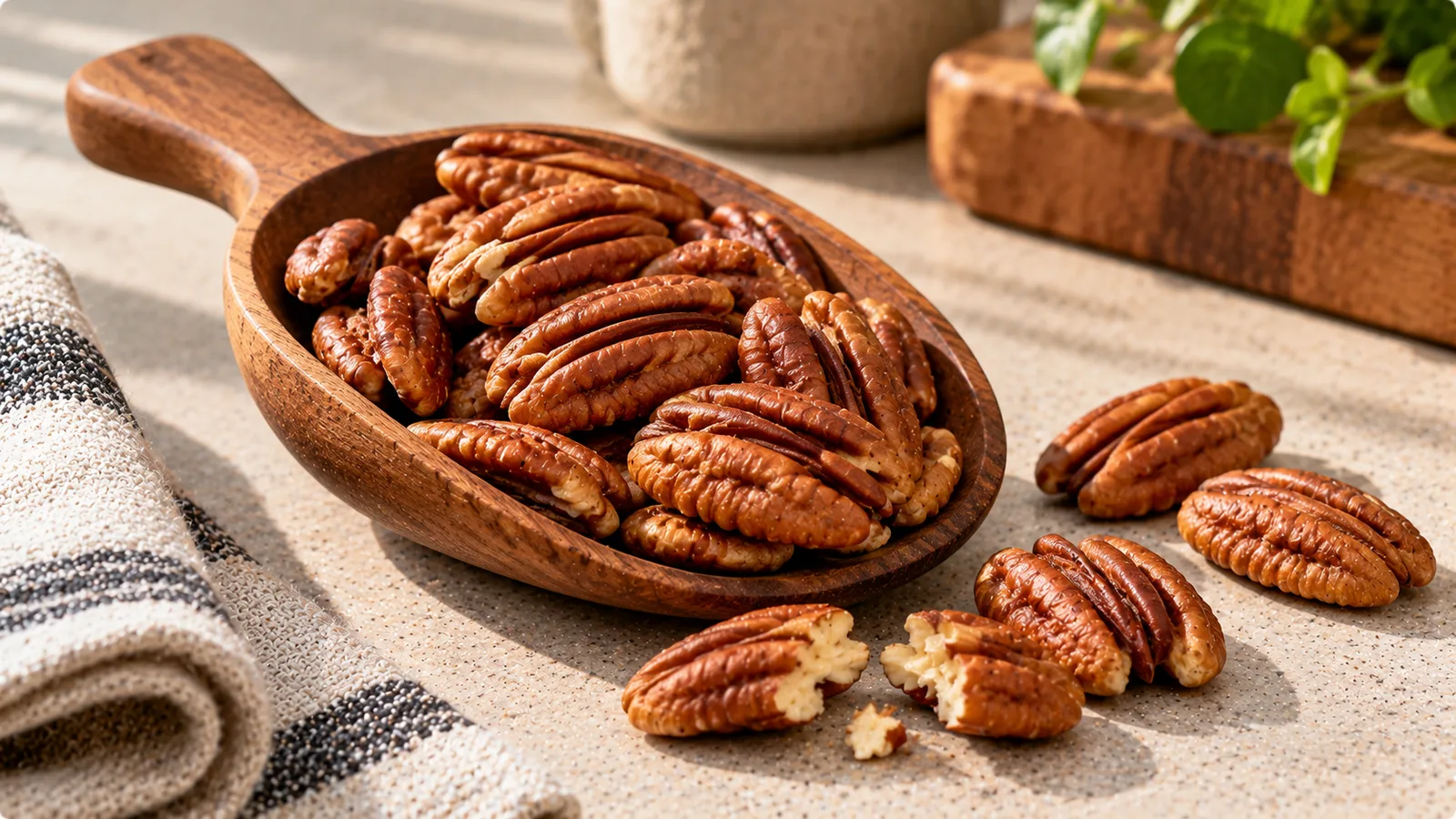
Pecans are rich, buttery-tasting tree nuts commonly eaten as a snack, added to breakfast bowls or used in baked goods.
They are also energy-dense. A relatively small serving can contribute a substantial number of calories, mostly from fat.
For calorie tracking, the most useful number is the weight of the edible pecan kernels rather than the number of pieces or the size of a handful.
Plain raw pecans provide approximately 691 kcal per 100 g, or 207 kcal per 30 g.
The calculations below use rounded reference values for raw pecans from USDA FoodData Central. Individual database entries, brands and preparations may differ slightly.
How many calories are in pecans?
| Edible pecans | Approximate calories |
|---|---|
| 5 g | 35 kcal |
| 10 g | 69 kcal |
| 15 g | 104 kcal |
| 20 g | 138 kcal |
| 25 g | 173 kcal |
| 28 g | 193 kcal |
| 30 g | 207 kcal |
| 40 g | 276 kcal |
| 50 g | 346 kcal |
| 100 g | 691 kcal |
All weights refer to the edible kernels without shells.
These figures are calculated using 691 kcal per 100 g and rounded to the nearest whole calorie.
For example:
30 × 691 ÷ 100 = 207.3 kcal.
A portion weighing 30 g therefore contains approximately 207 kcal.
This calculation is more reliable than assuming that every handful contains the same number of nuts.
Pecan nutrition per 100 g
Raw pecans contain substantial amounts of fat, smaller quantities of carbohydrate and protein, and dietary fibre.
| Nutrient | Approximate amount per 100 g |
|---|---|
| Energy | 691 kcal |
| Protein | 9.2 g |
| Total fat | 72.0 g |
| Saturated fat | 6.2 g |
| Carbohydrate, by difference | 13.9 g |
| Dietary fibre | 9.6 g |
| Total sugars | 4.0 g |
Source: USDA FoodData Central, raw pecans.
Important: USDA carbohydrate-by-difference figures include fibre. EU food labels generally report available carbohydrate separately from fibre. Do not add the USDA carbohydrate and fibre values together as though they were independent components.
Nutrition-label calories may also differ from calculations made using rounded macronutrients.
Use the values on the actual package when tracking a specific commercial product.
Nutrition in a 30 g serving
A 30 g portion is a convenient reference for comparing pecans with other nuts.
| Nutrient | Approximate amount in 30 g |
|---|---|
| Calories | 207 kcal |
| Protein | 2.8 g |
| Fat | 21.6 g |
| Saturated fat | 1.9 g |
| Carbohydrate, USDA definition | 4.2 g |
| Fibre | 2.9 g |
| Sugars | 1.2 g |
These values are calculated from the per-100 g figures and rounded.
Pecans are not particularly high in protein compared with some other nuts or with protein-rich foods such as yogurt, eggs and legumes.
Their defining nutritional feature is their high fat content.
Why are pecans so high in calories?
Fat supplies approximately 9 kcal per gram, compared with approximately 4 kcal per gram for protein and digestible carbohydrate.
Pecans contain roughly 72 g of fat per 100 g.
That explains much of their high energy density.
However, calorie density is not the same as poor nutritional quality.
Pecans contain predominantly unsaturated fats, as well as fibre and several micronutrients.
The WHO healthy diet guidance discusses the importance of fat quality and recommends favouring unsaturated fats over saturated and trans fats.
The practical consideration is portion size.
A 20 g serving may fit comfortably into a meal or snack, while repeatedly adding large unmeasured quantities can change daily energy intake considerably.
How much is a handful of pecans?
A handful is not a standardized unit.
Its weight depends on hand size, whether the pecans are whole or chopped, and how tightly they are held.
For meal planning, it is better to use a reference portion:
- 10 g: a small topping.
- 20 g: a modest snack or generous topping.
- 30 g: a larger measured portion.
- 50 g: a substantial quantity that contributes about 346 kcal.
These are descriptive examples, not universal dietary recommendations.
If you normally estimate pecans by handful, weigh your usual portion once or twice to learn its approximate mass.
Do not assume that a handful always equals 30 g.
Calories in pecan halves
Pecan halves vary in size.
A commonly used approximate reference is around 1.5 g per half, but actual weights can differ.
Using that illustrative weight:
| Pecan halves | Estimated weight | Estimated calories |
|---|---|---|
| 2 halves | 3 g | 21 kcal |
| 4 halves | 6 g | 41 kcal |
| 6 halves | 9 g | 62 kcal |
| 10 halves | 15 g | 104 kcal |
| 20 halves | 30 g | 207 kcal |
These are estimates, not guaranteed piece weights.
Large pecan halves can weigh more than small ones.
For accurate logging, weigh the kernels instead of counting them.
Raw versus roasted pecans
Roasting changes moisture content and flavour.
The calorie content per 100 g may change somewhat as water is lost, even when no oil is added.
Dry-roasted pecans are not automatically identical to raw pecans in a nutrition database.
Oil-roasted pecans may contain additional fat depending on the preparation.
For a packaged roasted product, use its label.
For home roasting without added oil, weighing the finished edible portion and selecting a suitable database entry gives a more useful estimate than assuming a fixed calorie value for every preparation.
Salted pecans
Adding salt does not meaningfully increase calories.
However, salted pecans can contain considerably more sodium than plain unsalted pecans.
The amount depends on the manufacturer and recipe.
If sodium intake matters to you, compare the salt or sodium information on the package.
Plain pecans and salted pecans should not automatically be treated as nutritionally identical.
Candied and chocolate-covered pecans
Sweet coatings can change the nutritional profile substantially.
Candied pecans may contain added sugar, syrup or butter.
Chocolate-covered pecans include the energy and nutrients from the chocolate coating.
For example, 30 g of plain pecans and 30 g of chocolate-covered pecans do not contain the same amount of actual pecan kernels.
The overall calories depend on the proportions of nuts and coating.
Use the nutrition label for the finished product rather than applying raw-pecan values to the entire serving.
Pecans and protein
Pecans contain approximately 9.2 g protein per 100 g.
That equals around 2.8 g in a 30 g serving.
This makes them a contributor to daily protein intake, but not an especially concentrated protein source.
If your goal is to build a protein-rich breakfast, combining a measured portion of pecans with skyr, yogurt or another protein-containing food is more practical than relying on pecans alone.
For example, a yogurt bowl can use pecans primarily for flavour, texture and fat while the yogurt supplies more of the protein.
The exact total depends on the products and quantities.
Pecans and dietary fibre
Raw pecans provide approximately 9.6 g fibre per 100 g.
A 20 g serving supplies about 1.9 g.
A 30 g serving supplies about 2.9 g.
These amounts can contribute to daily fibre intake.
However, a small serving of pecans is not a substitute for fibre-rich foods such as vegetables, fruit, legumes and whole grains.
For a varied diet, combine different fibre sources rather than depending on one ingredient.
Vitamins and minerals in pecans
Pecans provide several micronutrients, including manganese, copper, zinc and thiamin.
The amounts vary with serving size and database entry.
Because pecans are generally eaten in portions much smaller than 100 g, it is important to consider the micronutrients in the actual portion rather than relying on impressive per-100 g figures.
Pecans also contain some vitamin E, but they should not be assumed to provide the same amount as almonds or sunflower seeds.
The NIH Office of Dietary Supplements vitamin E fact sheet explains dietary sources and vitamin E requirements.
For exact mineral and vitamin values, consult the relevant USDA FoodData Central entry.
Are pecans good for weight loss?
Pecans can fit into an eating pattern designed for weight management.
Whether they fit your calorie target depends primarily on the quantity consumed and the rest of your diet.
A measured 15–20 g portion can add flavour and texture to a meal without contributing as many calories as a large unmeasured serving.
For example:
- 10 g pecans: about 69 kcal.
- 20 g pecans: about 138 kcal.
- 30 g pecans: about 207 kcal.
- 50 g pecans: about 346 kcal.
These figures show why measuring the portion matters.
There is no need to exclude pecans solely because they are calorie-dense.
Likewise, eating pecans does not automatically cause weight loss.
Pecans in a calorie deficit
If you are tracking a calorie deficit, record the actual amount used.
A small topping of 10 g may be easy to accommodate.
A 40 g portion contributes approximately 276 kcal and may require more deliberate planning.
The same principle applies to nut butters, oils and seeds.
Energy-dense foods can be included in a balanced diet, but their portion sizes have a noticeable effect on total energy intake.
How to use pecans in meals
Pecans work well in both sweet and savoury combinations.
Yogurt bowl
Add 10–15 g chopped pecans to plain yogurt with pear or berries.
The nuts provide crunch and a buttery flavour.
Porridge
Scatter a measured amount over oatmeal.
Use fruit or cinnamon for additional flavour.
Salad
Combine pecans with leafy greens, roasted vegetables and a suitable protein source.
Measure the nuts separately from the dressing.
Baked goods
Pecans can be added to muffins, cakes and pies.
For homemade recipes, calculate the calories from all ingredients, not only the nuts.
Snack
Eat a measured portion with fruit.
This is easier to track than repeatedly taking nuts directly from a large bag.
Example: pecans in a breakfast bowl
Suppose you prepare a bowl with:
| Ingredient | Quantity |
|---|---|
| Plain yogurt | 200 g |
| Pear | 150 g |
| Rolled oats | 25 g |
| Pecans | 15 g |
The pecans alone contribute approximately 104 kcal.
The total meal energy depends on the yogurt type and the other ingredients.
If you increase the pecans from 15 g to 30 g, the nuts contribute approximately 104 additional kcal.
This illustrates how a small weight change can affect the total without dramatically changing the visible volume of the meal.
How to weigh pecans accurately
Use a kitchen scale and a small bowl.
- Place the empty bowl on the scale.
- Press the tare button.
- Add the desired quantity of pecan kernels.
- Record the weight.
- Use the same weight in your nutrition app.
If you are preparing a recipe, weigh the total quantity added to the recipe.
Then divide the recipe into the actual number of servings.
Do not weigh shells as part of the edible portion.
How to log pecans in a nutrition app
Choose an entry matching the preparation:
- Raw pecans.
- Dry-roasted pecans.
- Oil-roasted pecans.
- Salted pecans.
- Candied pecans.
- Chocolate-covered pecans.
For a plain raw product, use approximately 691 kcal per 100 g as a reference if a more specific label is unavailable.
For packaged products, the package information is generally the better choice.
Enter the weight in grams rather than selecting an undefined handful.
Allergies and food safety
Pecans are tree nuts and can cause allergic reactions in susceptible individuals.
They are not an appropriate substitute for another nut when a person has a tree-nut allergy unless a qualified healthcare professional has confirmed suitability.
Check packaging for relevant allergen information.
In the EU, the Food Information to Consumers Regulation establishes requirements for declaring specified allergens.
Store pecans according to the package instructions.
Because their fats can deteriorate over time, avoid using nuts with an unusual rancid smell or taste.
The key numbers to remember
For plain raw pecans:
- 100 g: approximately 691 kcal.
- 30 g: approximately 207 kcal.
- 20 g: approximately 138 kcal.
- 10 g: approximately 69 kcal.
Most of the energy comes from fat.
Pecans also provide fibre, some protein and micronutrients.
For accurate tracking, use edible weight, check the preparation method and treat handfuls or piece counts as rough estimates.