
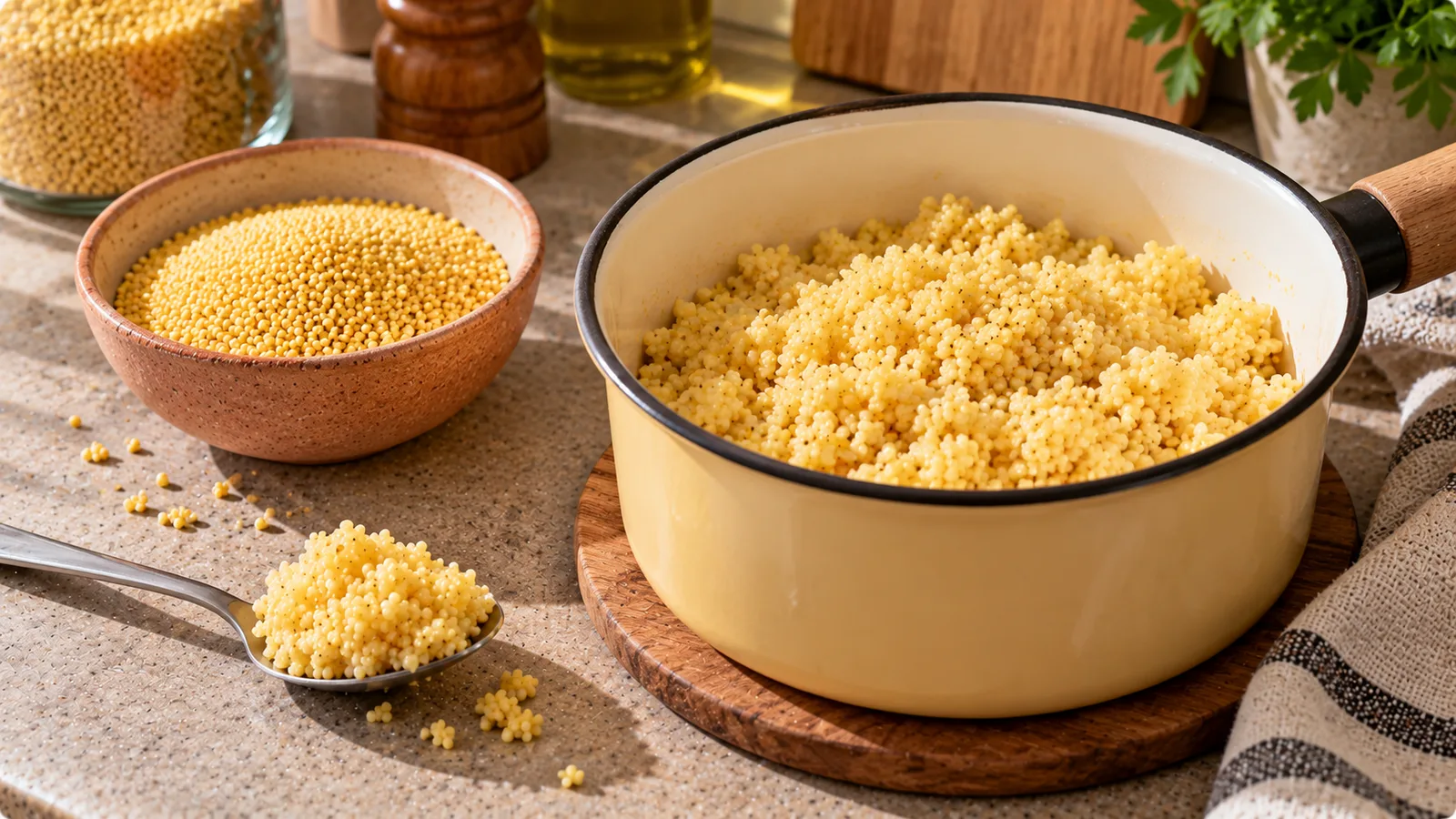
Millet is a small-grained cereal used in porridge, grain bowls, side dishes and savory recipes. It can be cooked until fluffy, served as a soft breakfast cereal or added to soups and vegetable dishes.
One of the most confusing things about tracking millet is the difference between dry and cooked weight.
A typical reference value for 100 g of dry millet is approximately 378 kcal, while 100 g of millet cooked in water contains approximately 119 kcal.
The difference is mostly water. Cooking makes millet heavier without adding calories when only water is used.
These figures are useful reference values, not guarantees for every variety, brand or preparation.
Millet calories at a glance
| Amount and preparation | Approximate calories |
|---|---|
| 25 g dry millet | 95 kcal |
| 40 g dry millet | 151 kcal |
| 50 g dry millet | 189 kcal |
| 60 g dry millet | 227 kcal |
| 75 g dry millet | 284 kcal |
| 100 g dry millet | 378 kcal |
| 100 g cooked millet in water | 119 kcal |
| 150 g cooked millet in water | 179 kcal |
| 200 g cooked millet in water | 238 kcal |
| 250 g cooked millet in water | 298 kcal |
Values are rounded from generic food composition data.
The cooked entries use a standard cooked-millet reference, not a fixed conversion from the dry entries.
Actual cooked calories per 100 g depend on how much water the grains absorb and retain.
Nutrition facts: dry millet versus cooked millet
The following figures describe plain millet without oil, butter, milk, sugar or sauces.
| Nutrient | Dry millet, 100 g | Cooked millet, 100 g |
|---|---|---|
| Energy | ~378 kcal | ~119 kcal |
| Protein | ~11.0 g | ~3.5 g |
| Total fat | ~4.2 g | ~1.0 g |
| Total carbohydrate, US database convention | ~72.9 g | ~23.7 g |
| Dietary fiber | ~8.5 g | ~1.3 g |
| Water | ~8.7 g | ~71.4 g |
These are approximate generic reference values.
A crucial labeling distinction: US food composition databases commonly report total carbohydrate including dietary fiber. EU nutrition labels report carbohydrate excluding fiber and list fiber separately when declared.
Do not add fiber to an EU carbohydrate number or subtract it from a US value without understanding the reporting convention.
The dry and cooked entries may also come from different analytical samples. Their nutrient ratios should not be treated as an exact cooking-yield equation.
Why cooked millet has fewer calories per 100 g
Millet absorbs water as it cooks.
Water adds weight but provides no energy.
Imagine starting with 60 g of dry millet:
60 × 378 ÷ 100 = approximately 227 kcal.
If the cooked batch weighs 180 g and contains only the millet and water, its energy remains approximately 227 kcal.
The energy per 100 g of that specific batch is:
227 ÷ 180 × 100 = approximately 126 kcal.
If the same dry quantity instead yields 210 g of cooked millet, the energy density becomes:
227 ÷ 210 × 100 = approximately 108 kcal per 100 g.
Both outcomes can be reasonable depending on water absorption, cooking time and final moisture.
That is why a generic database value of 119 kcal per 100 g cooked may differ from the value calculated for your own batch.
How much does millet weigh after cooking?
A practical starting estimate is that dry millet may produce roughly 2.5–3.5 times its original weight after cooking, depending on the method and desired texture.
For example:
| Dry millet | Possible cooked yield |
|---|---|
| 40 g | 100–140 g |
| 50 g | 125–175 g |
| 60 g | 150–210 g |
| 75 g | 188–263 g |
| 100 g | 250–350 g |
These are illustrative yield ranges, not a universal conversion rule.
A thick millet porridge may contain much more liquid than a fluffy side dish.
The most accurate approach is to weigh the finished batch.
How to calculate millet calories accurately
If you cook millet at home, use this method.
Step 1: Weigh the dry grains
For example, measure 150 g of dry millet.
Using 378 kcal per 100 g:
150 × 3.78 = 567 kcal.
Step 2: Cook with water
Cook the millet using your preferred method.
If you add only water, the total energy from the millet remains approximately 567 kcal.
If you add oil, milk, butter or other ingredients, count them separately.
Step 3: Weigh the cooked batch
Suppose the finished millet weighs 450 g.
Step 4: Calculate energy density
567 ÷ 450 × 100 = 126 kcal per 100 g.
Step 5: Weigh your serving
A 180 g serving from this batch contains:
180 × 126 ÷ 100 = approximately 227 kcal.
This approach avoids assuming that every cooked batch has exactly the same water content.
Millet serving sizes
A sensible portion depends on the meal, appetite, activity and other foods on the plate.
| Typical use | Dry quantity | Approximate energy |
|---|---|---|
| Small addition to soup or salad | 25–35 g | 95–132 kcal |
| Moderate side dish | 40–50 g | 151–189 kcal |
| Larger grain portion | 60–75 g | 227–284 kcal |
| Large grain-centered meal | 80–100 g | 302–378 kcal |
These are examples, not prescribed serving sizes.
A millet bowl with beans, vegetables and dressing will have a different total energy content from plain millet.
For calorie tracking, measure the millet separately from its toppings.
Is millet high in carbohydrates?
Millet is a cereal grain, so carbohydrates make up much of its dry weight.
Dry millet provides roughly 73 g of total carbohydrate per 100 g under the common US database convention.
Cooked millet provides approximately 24 g of total carbohydrate per 100 g, because the grains contain substantially more water.
This does not mean cooking removes most of the carbohydrates.
The same dry grains still contain broadly the same carbohydrate energy after cooking, apart from possible small losses into discarded cooking liquid.
Millet can fit into many eating patterns, but portion size matters when managing carbohydrate intake.
How much protein does millet contain?
Dry millet contains approximately 11 g of protein per 100 g.
A 50 g dry serving therefore supplies roughly 5.5 g of protein before considering other ingredients.
The protein is useful, but millet alone is not usually a particularly concentrated protein source compared with tofu, lentils, beans, fish or eggs.
To make a more protein-rich meal, pair millet with:
- Lentils or beans.
- Tofu or tempeh.
- Yogurt or skyr, if dairy is suitable.
- Eggs.
- Fish or poultry.
For plant-based meals, combining millet with legumes is a practical way to increase the overall protein content and variety.
What about fiber?
Millet contains dietary fiber, although the amount varies by grain type, processing and food database.
A generic dry-millet reference provides about 8.5 g of fiber per 100 g.
A generic cooked reference may show around 1.3 g per 100 g.
These two entries should not be assumed to represent the same grain batch before and after cooking.
Processing, analytical differences and water content affect reported values.
If fiber intake is important, use the specific product label when available.
Is millet gluten-free?
Millet is naturally gluten-free.
However, millet products may be contaminated with wheat, barley or rye during growing, transport, processing or packaging.
For people with celiac disease or a medically necessary gluten-free diet, choose millet products appropriately labeled gluten-free and follow relevant clinical guidance.
Do not assume that every millet flour, grain mix or processed millet product is safe solely because millet itself does not naturally contain gluten.
Millet versus rice, quinoa and couscous
Calories are often similar across cooked grains because water content affects the weight.
The following are broad reference ranges per 100 g cooked in water:
| Food | Approximate calories |
|---|---|
| Millet | ~119 kcal |
| White rice | ~130 kcal |
| Brown rice | ~110–125 kcal |
| Quinoa | ~120 kcal |
| Couscous | ~112 kcal |
Values vary by product, cooking method and water absorption.
A difference of a few calories per 100 g is usually less important than the portion size and added ingredients.
Millet and quinoa are naturally gluten-free grains or pseudocereals, while conventional wheat couscous contains gluten.
Millet porridge calories
Millet porridge can be quite different from plain cooked millet.
Its energy depends on what you use to prepare it.
For example, consider:
- 50 g dry millet: approximately 189 kcal.
- 200 ml unsweetened milk or plant drink: depends on the product.
- 10 g honey: approximately 30 kcal.
- 15 g nuts: often around 85–100 kcal, depending on the variety.
The millet alone contributes about 189 kcal.
Milk, sweeteners, nuts and toppings must be added to calculate the complete bowl.
Cooking the millet in more water makes the porridge heavier and less calorie-dense per 100 g, but does not reduce the total calories of the dry millet.
Does toasting millet change its calories?
Lightly toasting dry millet before cooking may change its flavor and aroma.
It does not meaningfully remove the grain's energy.
If you toast millet in oil, include the oil in your calculation.
One teaspoon of oil can add approximately 40–45 kcal depending on its actual weight.
The best way to track toasted millet is to record the dry grain weight and any added fat.
Can millet support weight management?
Millet can be part of a balanced eating pattern, including one designed for weight management.
It is not inherently a weight-loss food, and eating millet does not independently create a calorie deficit.
What matters is the overall diet, portion size and energy intake over time.
A practical millet meal might include:
- A measured portion of cooked millet.
- A generous amount of vegetables.
- A meaningful protein source.
- A moderate amount of oil or dressing.
This combination can provide variety and make the meal more satisfying.
There is no need to avoid millet simply because it contains carbohydrates.
Common calorie-tracking mistakes
Logging cooked millet as dry
Entering 150 g of dry millet when you actually ate 150 g cooked can dramatically overestimate calories.
Always check the database entry.
Logging dry millet as cooked
This creates the opposite problem and can substantially underestimate intake.
Using a generic cooked value for every batch
Different cooking yields produce different calories per 100 g.
Weighing your own batch is more accurate.
Forgetting cooking fats
Oil or butter added to the pan contributes calories even when the grain absorbs it.
Counting toppings as part of plain millet
Nuts, cheese, sauces, sugar and dressings can change the meal's nutritional profile significantly.
Confusing millet with millet flour
Flour, puffed millet and ready-made millet products may have different nutritional values and serving conventions.
Use the correct product entry.
Frequently asked questions
How many calories are in 100 g of millet?
Approximately 378 kcal if dry, or around 119 kcal if cooked in water, using common generic reference values.
How many calories are in 50 g of dry millet?
About 189 kcal before adding other ingredients.
How many calories are in 200 g of cooked millet?
Approximately 238 kcal using the generic cooked-millet reference. Your own batch may differ.
Is millet lower in calories than rice?
Cooked millet and rice have broadly comparable energy density. Water absorption and serving size can matter more than the small differences between generic database entries.
Does millet lose calories when cooked?
Cooking with water mainly changes the grain's weight and moisture. The total energy of the starting dry millet remains broadly similar if cooking liquid is not discarded with significant solids.
Is millet a good source of protein?
It contributes some protein but is not as concentrated a source as legumes, tofu or many animal protein foods.
Sources and data interpretation
- USDA FoodData Central — generic food composition data for raw and cooked millet.
- European Commission: Food Information to Consumers — EU food labeling framework.
- Celiac Disease Foundation — information on gluten sources and cross-contact.
Reference values are rounded and may differ from the product you buy.
Bottom line
Millet contains approximately 378 kcal per 100 g dry and 119 kcal per 100 g cooked in water according to common reference entries.
The difference is primarily water, not lost energy.
For the most reliable calorie calculation, weigh millet before cooking, calculate the total recipe energy and divide by the actual finished weight.
That method is especially useful when you prepare large batches or track portions precisely.