
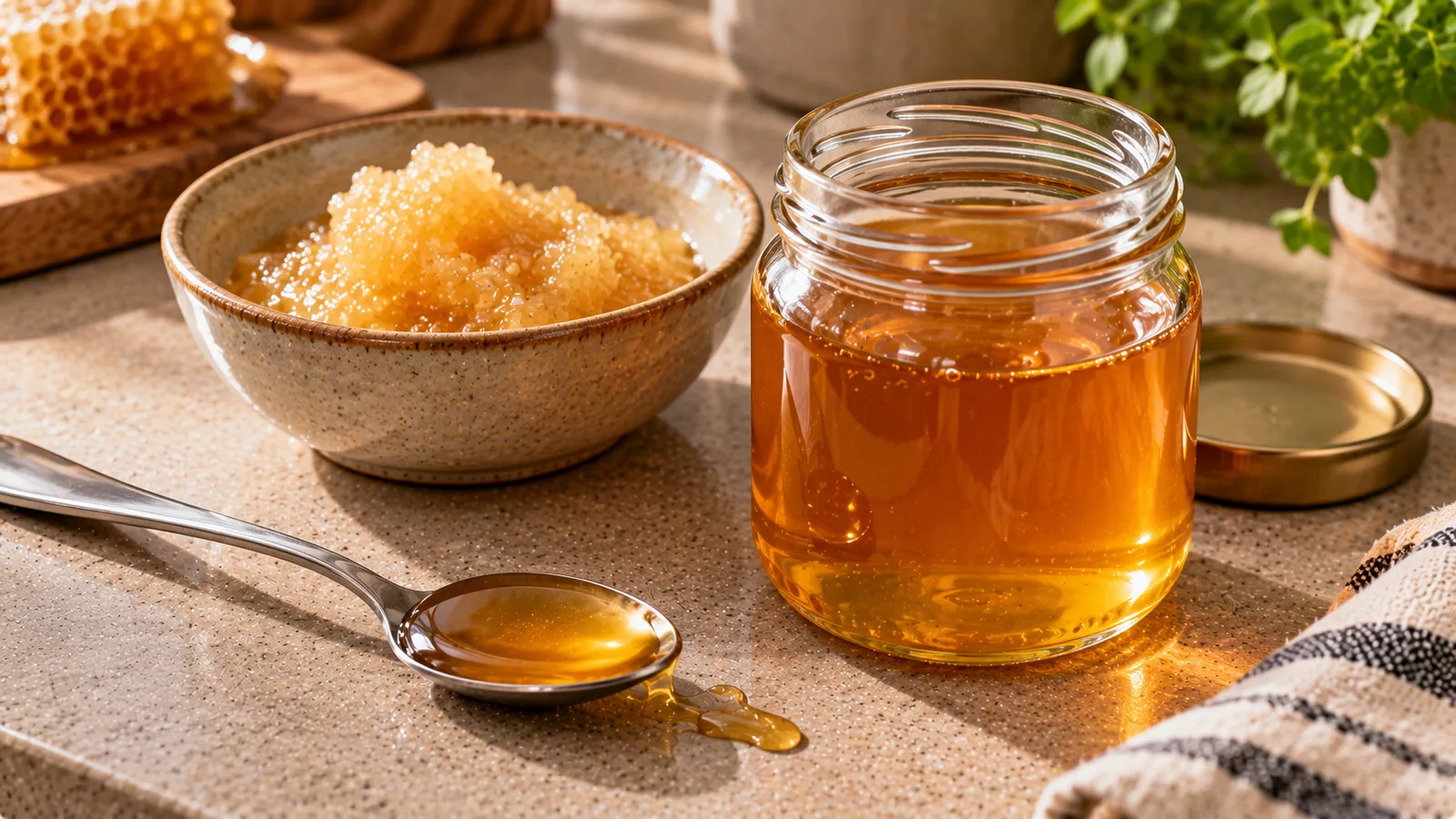
Honey is a concentrated sweetener, so a relatively small amount can contribute a noticeable number of calories. The useful question is not simply how many calories honey contains, but how much honey you actually add to a drink, breakfast or recipe.
According to USDA FoodData Central, plain honey provides approximately 304 kcal per 100 g, with 82.4 g of carbohydrate, almost all of it sugars. It contains negligible fat and very little protein.
A standard reference tablespoon weighing 21 g provides approximately 64 kcal. A reference teaspoon weighing 7 g provides approximately 21 kcal.
These are reference weights, not guarantees that every household spoon contains exactly the same amount.
Honey calories by serving size
The following values are calculated from the USDA reference of 304 kcal per 100 g.
| Honey amount | Calories | Carbohydrates | Total sugars |
|---|---|---|---|
| 5 g | 15 kcal | 4.1 g | 4.1 g |
| 1 reference teaspoon, 7 g | 21 kcal | 5.8 g | 5.7 g |
| 10 g | 30 kcal | 8.2 g | 8.2 g |
| 15 g | 46 kcal | 12.4 g | 12.3 g |
| 1 reference tablespoon, 21 g | 64 kcal | 17.3 g | 17.2 g |
| 25 g | 76 kcal | 20.6 g | 20.5 g |
| 30 g | 91 kcal | 24.7 g | 24.6 g |
| 50 g | 152 kcal | 41.2 g | 41.1 g |
| 100 g | 304 kcal | 82.4 g | 82.1 g |
Source: USDA FoodData Central, honey, FDC 169640. Serving figures are scaled mathematically and rounded; the underlying food-composition values are averages.
For an arbitrary portion, use:
Calories = honey weight in grams × 3.04
For example, 18 g of honey provides approximately 18 × 3.04 = 55 kcal.
This calculation is more useful than assuming every spoonful has the same weight.
Nutrition facts per 100 grams
Honey's energy comes overwhelmingly from carbohydrate.
| Nutrient | Amount per 100 g |
|---|---|
| Energy | 304 kcal |
| Carbohydrate | 82.4 g |
| Total sugars | 82.1 g |
| Protein | 0.3 g |
| Total fat | 0 g |
| Dietary fiber | 0.2 g |
| Water | 17.1 g |
Source: USDA FoodData Central.
The carbohydrate figure includes sugars; sugar should not be added to carbohydrate a second time when calculating totals.
Honey is not a meaningful source of protein or dietary fiber at normal serving sizes. Although it contains small amounts of micronutrients, those quantities do not make it a practical replacement for nutrient-dense foods.
How many calories are in a teaspoon of honey?
Using the reference weight of 7 g, one teaspoon contains about 21 kcal and 5.8 g carbohydrate.
But a teaspoon is a volume measure, and real portions differ.
A shallow teaspoon, a level teaspoon and a heaped teaspoon may contain different amounts. Honey can also cling to the spoon or remain in the jar.
If a teaspoon actually contains 10 g rather than 7 g, the energy is approximately 30 kcal instead of 21 kcal.
For casual tracking, a reference teaspoon may be sufficient. For more precise tracking, weigh the amount used.
How many calories are in a tablespoon?
A reference tablespoon of 21 g contains approximately 64 kcal, 17.3 g carbohydrate and 17.2 g sugar, calculated from USDA data.
Two such tablespoons provide approximately 128 kcal.
Three provide approximately 192 kcal.
A heaped tablespoon may weigh more than 21 g. Conversely, a partially filled tablespoon weighs less.
The amount in grams is the determining factor.
Why honey calories vary between jars
Honey is not a perfectly uniform product.
Its composition varies with floral origin, moisture content, processing and storage. Water contributes weight but no calories, so differences in water concentration can affect energy per 100 g.
The USDA value of 304 kcal per 100 g is a useful generic reference, not a laboratory measurement of every variety.
The product label should take priority when it gives a reliable nutrition declaration for the specific honey you are consuming.
If a label reports 320 kcal per 100 g, for example, a 20 g portion should be calculated as:
20 × 320 ÷ 100 = 64 kcal.
That example demonstrates the calculation and does not establish that a particular honey variety always contains 320 kcal.
Honey versus granulated sugar
Honey and table sugar are both concentrated sources of sweetness, but comparing them requires consistent units.
Generic USDA food-composition data place honey at approximately 304 kcal per 100 g. Granulated sugar is approximately 387 kcal per 100 g in the corresponding USDA reference data, available through FoodData Central.
On an equal-weight basis, honey therefore provides fewer calories in these reference datasets, largely because it contains water.
However, equal spoon volumes are not equal weights. Honey is denser than granulated sugar, and a spoonful of honey may weigh substantially more.
Replacing one tablespoon of sugar with one tablespoon of honey does not automatically reduce the calories in a recipe.
For an accurate substitution comparison, weigh both ingredients and calculate the amount actually used.
Is honey healthier because it is natural?
Honey contains naturally occurring sugars, but that does not mean its sugars can be ignored in dietary planning.
The World Health Organization's healthy diet guidance includes sugars naturally present in honey within the definition of free sugars.
This matters when interpreting recommendations to limit free sugar intake. Honey is not exempt merely because it is produced by bees or sold without additional ingredients.
The practical distinction is between using a modest amount for flavor and assuming that a natural sweetener can be consumed without regard to quantity.
A tablespoon may fit into someone's eating pattern, but its contribution to total sugar and energy intake still counts.
Honey in tea, yogurt and breakfast
The calories in a prepared meal depend on the amount of honey added, not the size of the bowl or cup.
Consider these illustrative examples:
| Use | Honey added | Calories from honey |
|---|---|---|
| Tea | 7 g | 21 kcal |
| Plain yogurt | 15 g | 46 kcal |
| Porridge | 20 g | 61 kcal |
| Pancake topping | 30 g | 91 kcal |
All figures use the USDA reference and exclude the other ingredients.
If a bowl of yogurt contains 150 kcal before honey, adding 15 g of honey raises the estimated total to approximately 196 kcal.
The same principle applies to marinades, dressings, sauces and baking.
Measuring honey accurately
A small kitchen scale offers the most reproducible method.
- Place the bowl or container on the scale.
- Set the display to zero.
- Add honey until the desired weight is reached.
- Record the gram amount in your food diary or recipe.
For a drink, you can also weigh the honey container before and after pouring. The difference is the quantity used.
When preparing several servings, record the total honey added to the recipe and divide it by the number of portions actually obtained.
For example, if 60 g of honey is divided equally among six servings, each serving contains 10 g, or approximately 30 kcal from honey.
If portions are unequal, calculate using their actual weights rather than assuming an even split.
Raw honey, filtered honey and crystallized honey
Labels such as raw, filtered, unfiltered or crystallized describe aspects of processing or physical state. They do not establish a universal calorie difference.
Crystallization changes texture; it does not, by itself, remove the sugars already present.
When comparing products, use the declared nutrition per 100 g rather than assigning a different calorie value solely because one honey is crystallized.
Likewise, color and floral variety alone are not reliable calorie calculators.
Honey and infant safety
Honey must not be given to children younger than 12 months because of the risk of infant botulism, including honey used as an ingredient in food. See the US Centers for Disease Control and Prevention guidance.
This warning concerns food safety rather than calorie content.
For older children and adults, honey can be evaluated as a sweetener within the overall diet, taking individual medical circumstances into account.
What to enter in a calorie-tracking app
For plain honey without a specific branded nutrition entry, a reasonable generic starting point is:
| Tracking field | Reference value |
|---|---|
| Food | Honey |
| Quantity unit | Grams |
| Calories per 100 g | 304 kcal |
| Carbohydrate per 100 g | 82.4 g |
| Protein per 100 g | 0.3 g |
| Fat per 100 g | 0 g |
Source: USDA FoodData Central.
For a packaged product, prefer the nutrition label when it provides a different value.
Avoid recording a heaped spoon as a standard teaspoon without checking the quantity.
The most reliable approach is simple: identify the honey, measure its weight and calculate the portion from its per-100-g nutrition values.