
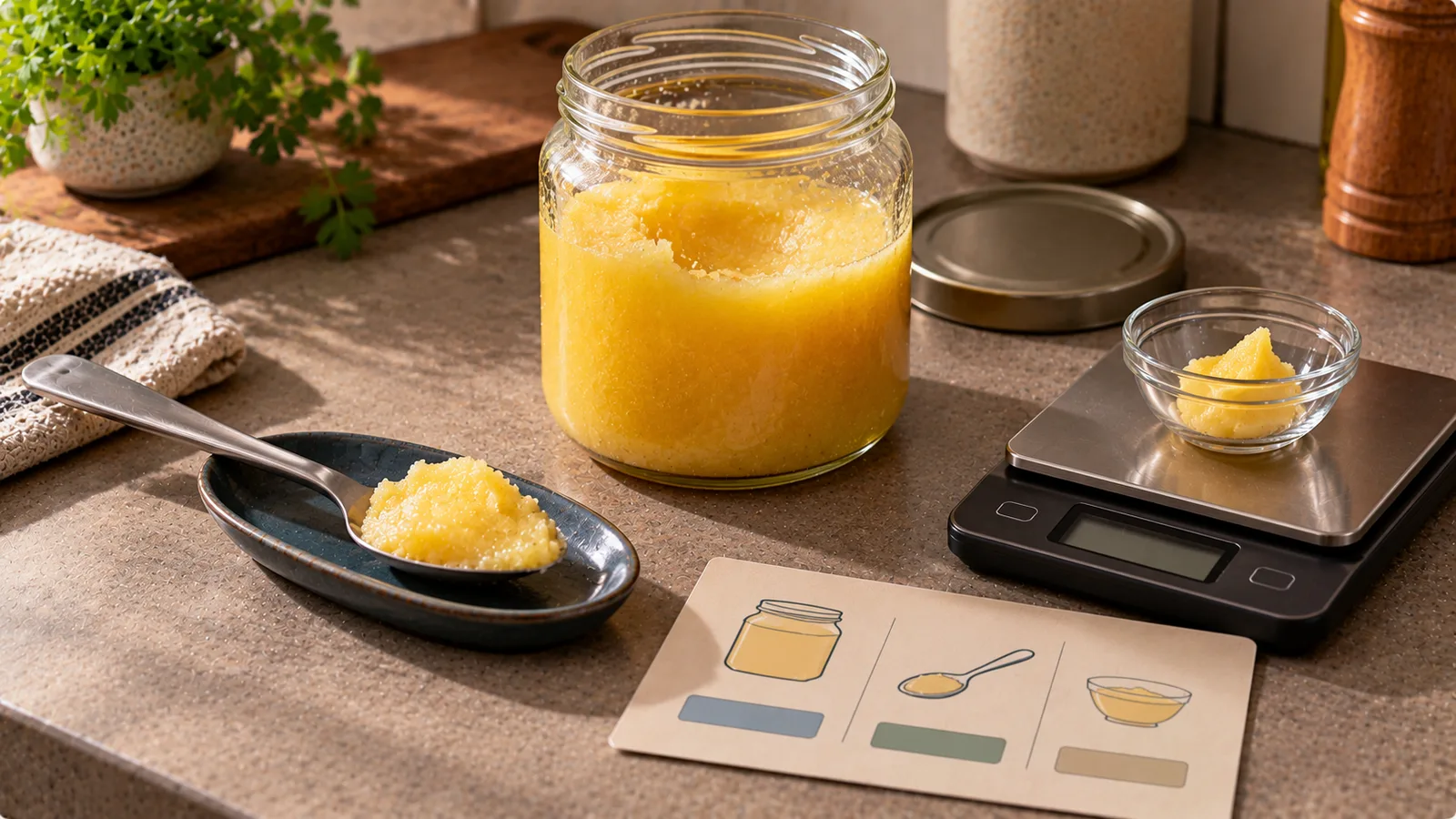
Ghee is a concentrated source of dietary fat, so relatively small portions can contain a substantial number of calories.
A typical ghee provides approximately:
880–900 kcal per 100 g
Most of those calories come from fat.
For everyday portions, a useful working estimate is about:
- 45 kcal per 5 g
- 90 kcal per 10 g
- 120–135 kcal per tablespoon, depending on the actual spoon weight
The exact value varies slightly by product, so the package label is the best source when available.
Ghee calories by serving size
Using a representative value of 900 kcal per 100 g, the calculation is straightforward:
| Ghee amount | Approximate calories |
|---|---|
| 1 g | 9 kcal |
| 3 g | 27 kcal |
| 5 g | 45 kcal |
| 10 g | 90 kcal |
| 15 g | 135 kcal |
| 20 g | 180 kcal |
| 30 g | 270 kcal |
| 50 g | 450 kcal |
| 100 g | 900 kcal |
Actual packaged products may be slightly below or above these figures.
How many calories are in 1 gram of ghee?
Ghee is almost entirely fat.
Fat provides approximately:
9 kcal per gram
That means one gram of ghee contains close to:
9 kcal
This makes gram-based calculations particularly convenient.
If you use 7 g:
7 × 9 = 63 kcal
If you use 12 g:
12 × 9 = 108 kcal
A product label may produce a slightly different result because ghee is not necessarily exactly 100% fat and nutrition values are rounded.
Calories in a teaspoon of ghee
A teaspoon is a volume measurement, not a fixed weight.
A level teaspoon of ghee may weigh roughly 4–5 g, depending on the product, temperature and how the spoon is filled.
At approximately 9 kcal per gram:
4 g = about 36 kcal
5 g = about 45 kcal
A practical estimate for a level teaspoon is therefore roughly:
35–45 kcal
If accurate tracking matters, weighing the portion is better than assuming every teaspoon has the same mass.
Calories in a tablespoon of ghee
A tablespoon is also a volume measure.
Depending on how it is filled, a tablespoon of ghee may weigh around 13–15 g.
That gives approximately:
13 g × 9 = 117 kcal
to:
15 g × 9 = 135 kcal
So a tablespoon can reasonably contain around:
120–135 kcal
A heaped spoon can contain considerably more.
Why spoon measurements vary
Two people can both report using one tablespoon of ghee while consuming different amounts.
The actual mass depends on:
- whether the spoon is level or heaped;
- whether the ghee is firm or liquid;
- the exact spoon size;
- how much remains on the spoon;
- how the product is transferred to the pan.
For approximate cooking, this difference may not matter.
For calorie tracking, grams are more reliable.
Ghee nutrition per 100 g
A typical plain ghee contains approximately:
| Nutrient | Typical amount per 100 g |
|---|---|
| Calories | 880–900 kcal |
| Fat | 98–100 g |
| Protein | 0–1 g |
| Carbohydrate | 0–1 g |
The exact composition depends on the product.
Because nearly all of the energy comes from fat, small differences in fat content can change the calorie value.
Why is ghee so calorie-dense?
Ghee contains very little water compared with many whole foods.
It is primarily milk fat.
Fat supplies approximately:
9 kcal per gram
Protein and carbohydrate provide roughly:
4 kcal per gram
A food made almost entirely of fat will therefore contain much more energy per gram than foods containing substantial amounts of water, protein or carbohydrate.
For example, 10 g of ghee contains close to 90 kcal even though the portion looks small.
What is ghee?
Ghee is a form of clarified butter.
Butter is heated so that much of its water is removed and milk solids are separated from the fat.
The remaining product is highly concentrated in milk fat.
This is why ghee and ordinary butter are related but are not identical products.
Ghee vs butter calories
Both ghee and butter are calorie-dense.
Regular butter usually contains some water and non-fat milk components, while ghee is more concentrated in fat.
A representative comparison might look like:
| Product | Approximate calories per 100 g |
|---|---|
| Butter | 710–750 kcal |
| Ghee | 880–900 kcal |
These are broad representative values rather than universal numbers.
Always compare the actual labels when choosing between specific products.
Why 10 g of ghee and 10 g of butter are different
If a butter contains approximately 82% fat, 10 g of that butter includes less total fat than 10 g of almost pure ghee.
Consequently, ghee usually provides more calories for the same gram weight.
This does not mean one is automatically better or worse.
It simply means their energy density differs.
Does melting ghee change its calories?
No.
Melting changes the physical state of the ghee, not the amount of energy in it.
If you melt:
10 g of ghee
you still have approximately the calories contained in those 10 g.
The volume can look different when the product is liquid, which is another reason weighing it can be useful.
Weight versus volume
Ghee is often measured in:
- grams;
- teaspoons;
- tablespoons;
- milliliters.
These units are not interchangeable without considering density.
A gram measures mass.
A milliliter measures volume.
Therefore:
10 ml of ghee is not automatically exactly 10 g
For a packaged product that gives nutrition per 100 g, weighing the ghee in grams provides the cleanest calculation.
How to calculate calories from the label
Suppose your ghee contains:
895 kcal per 100 g
and you use:
12 g
Calculate:
895 × 12 ÷ 100 = 107.4 kcal
You can log approximately:
107 kcal
For 18 g:
895 × 18 ÷ 100 = 161.1 kcal
So the portion contains approximately:
161 kcal
Example: ghee used for frying eggs
Suppose you put:
8 g ghee
into a pan.
Using 900 kcal per 100 g:
900 × 8 ÷ 100 = 72 kcal
The ghee added to the pan represents approximately:
72 kcal
However, the amount actually consumed can differ if some fat remains in the pan.
Ghee left in the pan
Adding 10 g of ghee to a pan does not always mean exactly 10 g ends up in the food.
Some may:
- remain on the pan;
- be discarded with cooking juices;
- remain on a serving utensil.
If you need a simple and consistent tracking method, logging the amount added is often practical.
If a meaningful amount clearly remains behind, the consumed quantity may be lower.
Avoid trying to estimate tiny residues with unrealistic precision.
Example: roasting vegetables
You use:
20 g ghee
for a tray of vegetables.
At approximately 9 kcal per gram:
20 × 9 = 180 kcal
If the tray makes four equal portions:
180 ÷ 4 = 45 kcal
of added ghee per portion, assuming the fat is distributed and consumed approximately evenly.
Example: ghee in rice
Suppose a pot of rice contains:
15 g ghee
The ghee contributes approximately:
15 × 9 = 135 kcal
If the cooked pot is divided into three equal portions:
135 ÷ 3 = 45 kcal
of ghee-derived energy per portion.
The rice itself must still be calculated separately.
Example: ghee in a curry
A curry recipe contains:
30 g ghee
Using 900 kcal per 100 g:
270 kcal
come from the ghee.
If the curry makes six equal servings:
270 ÷ 6 = 45 kcal
per serving from ghee.
The rest of the ingredients determine the remaining calories.
Small amounts can add up
Because ghee is energy-dense, several small additions can become meaningful over a day.
For example:
Breakfast:
5 g = about 45 kcal
Lunch:
8 g = about 72 kcal
Dinner:
10 g = about 90 kcal
Total:
23 g = about 207 kcal
This is not a reason to avoid ghee. It simply illustrates why measuring cooking fats can improve calorie estimates.
How to weigh ghee accurately
One simple method is:
- place the bowl, pan or food container on a kitchen scale;
- tare the scale to zero;
- add the ghee;
- read the weight in grams.
If the ghee is added directly from a jar and you want to avoid another dish, you can also use the difference method.
Difference method
Place the ghee container on the scale before cooking.
Suppose it weighs:
428 g
After taking ghee out, it weighs:
416 g
Amount used:
428 − 416 = 12 g
At roughly 9 kcal per gram:
12 × 9 = about 108 kcal
This can be convenient when the ghee is too firm to pour neatly.
What if you do not have a scale?
Use a consistent spoon measurement.
For example, if you usually use a level teaspoon, you can estimate roughly:
4–5 g
or approximately:
35–45 kcal
The uncertainty is larger than with weighing, but consistency is usually more useful than changing assumptions every time.
Is ghee carbohydrate-free?
Plain ghee generally contains negligible carbohydrate.
However, always check the label of the specific product.
Flavored or blended products can contain additional ingredients.
A product marketed with herbs, flavorings or other fats may not have the same nutrition profile as plain ghee.
Does ghee contain protein?
Plain ghee generally contains little to negligible protein.
Most milk proteins are removed with the milk solids during clarification.
Again, exact label values may differ slightly because of production methods and rounding.
What about lactose?
Ghee typically contains much less lactose than ordinary butter because milk solids are largely removed during clarification.
However, the exact residual amount depends on manufacturing.
People who need to avoid milk components for medical reasons should rely on appropriate product labeling and professional guidance rather than assuming every ghee product is completely free of them.
Saturated fat in ghee
A substantial proportion of the fat in ghee is saturated fat.
The exact amount varies by product.
If saturated-fat intake matters to your diet, check the product's nutrition label rather than focusing only on total calories.
Calories describe energy content; they do not describe the complete nutritional profile.
Ghee portions in cooking
A useful practical range is:
- 3–5 g for a small amount in a pan;
- 5–10 g for an individual serving or cooking portion;
- 15–30 g for a multi-serving recipe.
These are examples, not required serving sizes.
The amount that makes sense depends on the recipe and how many people it serves.
How much ghee is 50 calories?
Using approximately 9 kcal per gram:
50 ÷ 9 = 5.6 g
So roughly:
5–6 g of ghee
provides around 50 kcal.
How much ghee is 100 calories?
Calculate:
100 ÷ 9 = 11.1 g
So approximately:
11 g ghee
contains around 100 kcal.
If your product has a label value different from 900 kcal per 100 g, use that value for greater accuracy.
How much ghee is 200 calories?
At approximately 9 kcal per gram:
200 ÷ 9 = 22.2 g
So around:
22 g
provides approximately 200 kcal.
This illustrates how relatively small physical portions of concentrated fats can contain substantial energy.
Tracking homemade ghee
If you make ghee from butter at home, the final product loses water and milk solids.
Do not assume the finished ghee has the same calorie density per 100 g as the original butter.
If you need a practical tracking value, use a reliable generic ghee entry or calculate from the starting ingredients and final edible yield.
For example, if the calories from the butter used remain primarily in the recovered fat, the final product becomes more calorie-dense per gram as non-fat mass is removed.
Ghee in a multi-serving recipe
For a recipe, the cleanest method is to enter the total ghee used once.
Example:
Whole recipe:
25 g ghee
Ghee calories:
25 × 9 = approximately 225 kcal
If the recipe makes five equal servings:
225 ÷ 5 = 45 kcal per serving
from the ghee.
Do not add the same ghee again to individual servings if it is already included in the saved recipe.
If portions are unequal
Suppose a recipe contains 30 g ghee and is divided into portions of different sizes.
Instead of assuming each serving contains exactly the same amount, you can calculate the complete recipe and divide it by the final cooked weight.
For example:
Total recipe:
2,400 kcal
Final cooked weight:
1,600 g
Energy density:
2,400 ÷ 1,600 = 1.5 kcal/g
A 400 g portion contains:
400 × 1.5 = 600 kcal
The ghee is already included in that total.
Ghee calories at a glance
A practical reference using approximately 900 kcal per 100 g:
- 1 g: about 9 kcal
- 5 g: about 45 kcal
- 10 g: about 90 kcal
- 15 g: about 135 kcal
- 20 g: about 180 kcal
- 30 g: about 270 kcal
- 50 g: about 450 kcal
- 100 g: about 900 kcal
For teaspoons and tablespoons, the actual weight matters more than the spoon name.
The simplest way to track ghee
If you use ghee regularly and want consistent calorie estimates:
- check the calories per 100 g on your product;
- weigh the amount in grams;
- calculate calories from the actual weight;
- include it once in the meal or recipe;
- avoid assuming that every spoon contains exactly the same amount.
Because ghee is highly concentrated in fat, even a difference of 5 g represents roughly 45 kcal.
That makes gram-based measurement especially useful when portion accuracy matters.
Nutrition data sources
Reference values below are per 100 g of the specified food. Product varieties and preparation methods can differ.
- USDA FoodData Central — Butter, Clarified butter (ghee) (FDC 171314; 900 kcal/100 g).