
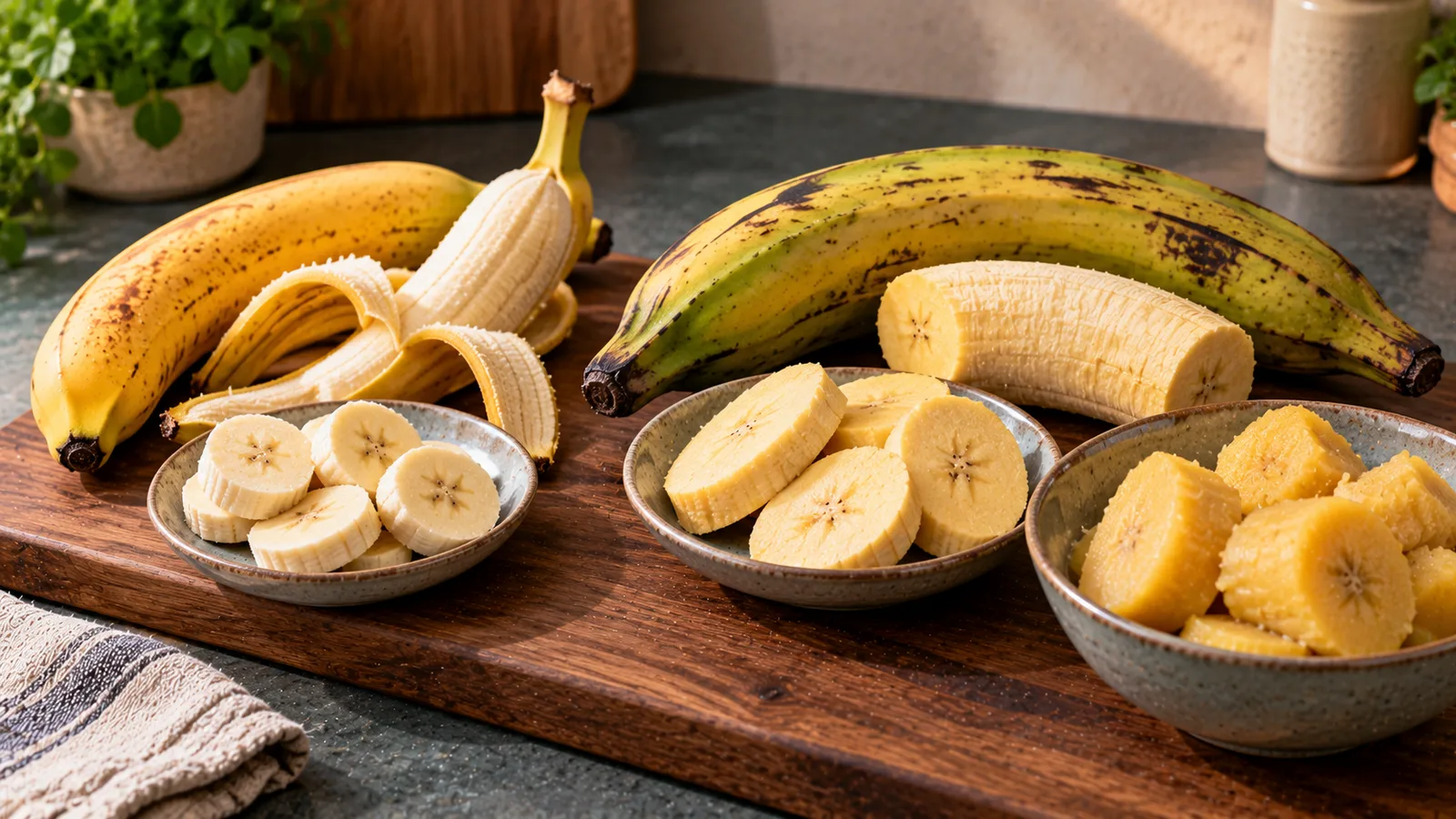
Two different foods, not two names for one banana
A sweet dessert banana and a cooking plantain belong to the same broader family, but they are not interchangeable entries in a food diary. A banana is usually eaten raw, while plantains—especially green ones—are more often boiled, steamed, baked or fried. The question is not whether either food is inherently “better”. It is how many carbohydrates you actually eat in a specified, edible portion, with the ripeness and preparation recorded.
For a fair starting point, the comparison below uses 150 g of edible food in each row. That means no peel, and a cooked weight for the boiled row. It does not mean that 150 g of raw plantain always becomes 150 g after cooking. Those are different measurements. This distinction matters more than the apparent similarity of the fruits.
Which food-composition entries are being compared?
The reference figures come from distinct USDA FoodData Central entries: raw banana, yellow plantain, raw, green plantain, raw, and green plantain, boiled. They represent different foods or preparation states, not before-and-after laboratory measurements of the same fruit. The banana reference contains 22.84 g carbohydrates per 100 g; yellow raw plantain has 31.89 g; green raw plantain has 36.66 g; and boiled green plantain has 29.15 g. The figures are carbohydrates by difference in the USDA system, which includes fibre.
Read the entries with their full descriptions, not merely the word “plantain”. Ripeness changes the distribution of starch and sugars; cooking changes moisture and the weight basis. Cultivar, growing conditions and individual fruit can also shift results. These are useful reference values, not guaranteed measurements of a banana from your own kitchen.
Carbohydrates in equal 150 g portions
| Food and state | Carbs per 100 g | Carbs per 150 g | Energy per 150 g |
|---|---|---|---|
| Banana, raw | 22.84 g | 34.3 g | 134 kcal |
| Yellow plantain, raw | 31.89 g | 47.8 g | 183 kcal |
| Green plantain, raw | 36.66 g | 55.0 g | 228 kcal |
| Green plantain, boiled | 29.15 g | 43.7 g | 182 kcal |
All rows refer to the edible portion. The cooked row is 150 g weighed after boiling, without added oil or sauce. Values are rounded at the portion level. A 150 g serving of raw yellow plantain supplies around 13.6 g more carbohydrate than 150 g of raw banana in these particular entries. The boiled-green and raw-yellow rows must not be interpreted as a controlled effect of boiling: they also differ in ripeness.
Calculate a portion without mixing weights
Use this rule: carbohydrates in your portion = carbohydrates per 100 g × edible portion weight ÷ 100. For example, 31.89 × 150 ÷ 100 = 47.835 g, displayed as 47.8 g for a 150 g raw yellow plantain portion. For a boiled green plantain portion, 29.15 × 150 ÷ 100 = 43.725 g, or 43.7 g. The same logic works for a smaller plate or a shared dish, provided the database state matches the food you weigh.
If you peel and weigh 180 g of raw banana, the calculation is 22.84 × 180 ÷ 100 = 41.112 g, about 41.1 g carbohydrates. Do not weigh the fruit with the peel, take a total weight and apply an unverified peel percentage. Weighing the edible portion directly removes that uncertainty. For a mixed recipe, account for each ingredient before dividing by the number or weight of servings.
Why raw and cooked weights can mislead
Boiling may add water to a food or remove soluble material; baking can reduce its water content. As the weight changes, nutrients per 100 g can change even when the amount retained in the entire prepared batch changes little. Therefore, 55.0 g in 150 g raw green plantain and 43.7 g in 150 g boiled green plantain do not prove that cooking eliminates exactly 11.3 g carbohydrate from the same 150 g starting piece.
To estimate retention for your actual pot, weigh the raw edible plantain, record the cooked yield, and use a documented cooking-retention method or a preparation-matched entry. Without that information, use the cooked database value against your cooked serving weight and present it as an estimate. Do not silently multiply a raw 100 g entry by the weight after boiling.
Ripeness changes the mix of starch and sugar
Unripe plantains are relatively starch-rich. With ripening, some starch is converted into sugars, affecting sweetness, texture and cooking behaviour. A ripe yellow plantain is not simply a green plantain painted a different colour. The USDA values above illustrate why the exact description must accompany a number: 36.66 g per 100 g for green raw plantain is not the same entry as 31.89 g per 100 g for yellow raw plantain.
Total carbohydrate and sugar are different measurements. A sweeter taste does not establish the total carbohydrate of your serving, nor does it show that one food has a particular blood-glucose effect in every person. If a product comes with a nutrition label, follow that label and its stated definition of carbohydrate rather than assuming the reference table applies exactly.
Boiled, baked or fried: count the whole preparation
Plain boiled plantain can be logged with a boiled entry and its finished edible weight. Roasting or baking without oil needs a compatible preparation entry or a carefully tracked raw-to-cooked yield. Frying adds another ingredient. Oil contributes calories and fat; it does not add plantain carbohydrate, but sweet glazes, flour coatings or sauces may add carbohydrates. A fried-plantain database record may already include oil, so adding all the cooking oil again could count it twice.
For a home recipe, record the plantain, the oil actually used or reasonably allocated, and any toppings separately. When the amount of absorbed oil cannot be measured, show the estimate as uncertain rather than claiming precision. It is misleading to compare a plain raw banana with a sweetened, oil-fried plantain and describe every difference as intrinsic to the fruit.
Calories, fibre and carbohydrate definitions
The approximate energy figures in the table are 134, 183, 228 and 182 kcal per 150 g, respectively, before additional cooking ingredients. They describe the listed USDA reference states. Calories are relevant to meal planning, but their presence does not make a raw and cooked comparison more exact. Fibre also matters, particularly when comparing a US database's total carbohydrate with labels in Europe.
USDA carbohydrate by difference includes dietary fibre. EU-style nutrition labels generally list available carbohydrate separately from fibre. Subtracting or mixing the two conventions without checking the source can produce conflicting numbers. Do not call the USDA figure “net carbs”, and do not treat the difference between two label systems as a nutrient change caused by cooking.
Mistakes to avoid when logging a plantain
The most common errors are choosing a banana entry for a plantain, selecting a ripe entry for a green fruit, forgetting that peels are excluded, and combining raw nutrient data with cooked weights. Another is treating a precise-looking table as if it measured your own fruit. Even a seemingly small mismatch becomes important when portions are large or repeated across a week.
Watch the serving basis, too. “One plantain” varies greatly in edible weight; 150 g is an explicit example, not a universal fruit size. If a dish contains several plantains, measure the finished batch and the serving removed from it. A side dish, a snack and a fried dessert may use the same fruit yet need different nutrition records.
A workable routine for everyday meal tracking
First, identify banana versus plantain and note whether the plantain is green or ripe. Second, choose the raw or cooked preparation that actually matches what is eaten. Third, weigh the edible portion in that same state. Fourth, calculate from the per-100 g reference; add oil, coatings or sweetened accompaniments only where applicable. Finally, round sensibly and record what is estimated rather than measured.
This comparison is designed to answer a portion question, not to replace a single-food profile or advise which fruit someone should eat. For general banana nutrition, a separate profile is more useful.
Sources
- USDA FoodData Central — search and data-type documentation. Entry descriptions used: Bananas, raw (SR Legacy 173944); Plantains, yellow, raw (SR Legacy 169130); Plantains, green, raw (168215); Plantains, green, boiled (168216).
- USDA-derived raw banana composition (173944).
- USDA-derived yellow raw plantain composition (169130).
- USDA-derived green raw plantain composition (168215).
- USDA-derived boiled green plantain composition (168216).