
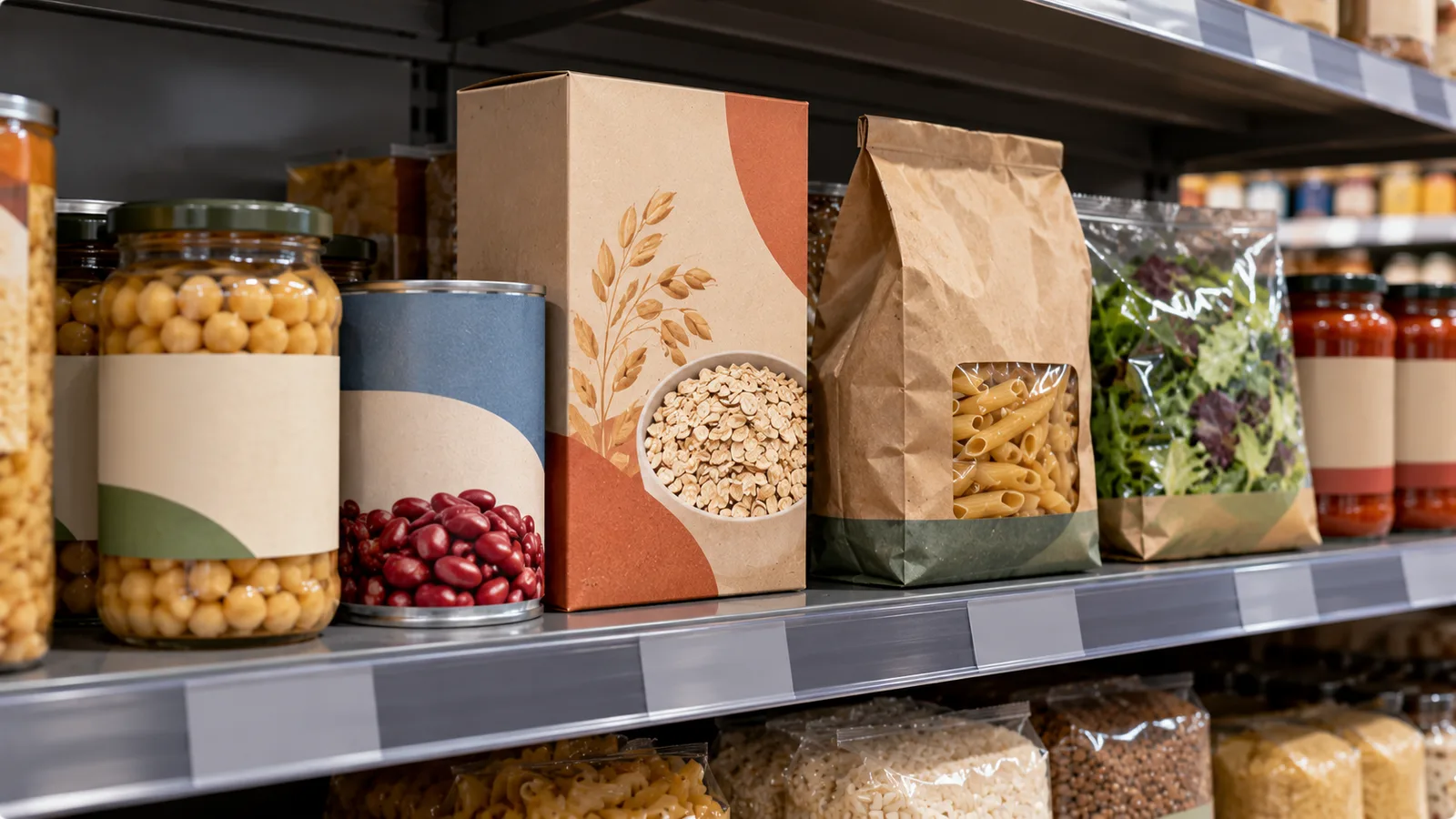
The European Union began applying a new framework for packaging and packaging waste on 12 August 2026. For grocery shoppers, the change matters because packaging affects food safety, waste sorting, deposit returns and the practical cost of shopping.
However, not every packaging requirement took effect on the same date. Some provisions apply in 2026, while major requirements concerning recyclability, recycled content, packaging formats and harmonised labels have later implementation dates.
The main legal instrument is Regulation (EU) 2025/40, the Packaging and Packaging Waste Regulation (PPWR). The European Commission confirmed the start of its application in August 2026.
This guide distinguishes the rules already applying from future obligations and explains what consumers can actually check on food packaging.
The key dates at a glance
| Date | What it means |
|---|---|
| 11 February 2025 | PPWR entered into force |
| 12 August 2026 | General application began; certain food-contact packaging restrictions apply |
| 2028 or later | Harmonised material-composition labelling begins according to the regulation's timing rules |
| 2030 | Major recyclability, recycled-plastic-content and selected packaging-format requirements are scheduled to apply |
| Later phases | Additional obligations and targets develop over time |
The distinction between entry into force and application is important. A law may already exist while specific obligations are not yet enforceable.
The dates above summarise the regulation and the Commission's implementation guidance. For labelling in particular, the exact date can depend on the adoption and entry into force of implementing acts.
What actually changed in August 2026?
The PPWR creates a more harmonised EU framework covering the life cycle of packaging: design, composition, placing on the market, reuse, collection and waste management.
For food shoppers, one of the most immediate measures concerns PFAS in food-contact packaging.
From 12 August 2026, the regulation restricts placing food-contact packaging on the market when specified PFAS concentration thresholds are met or exceeded.
These restrictions address certain per- and polyfluoroalkyl substances, a large chemical family used in some industrial applications.
The detailed thresholds and conditions are set out in Article 5 of Regulation (EU) 2025/40.
This does not mean every food wrapper on a shelf must display a new PFAS label. Compliance is primarily a responsibility of the businesses placing packaging on the market and the relevant enforcement authorities.
Does this mean all food packaging is PFAS-free?
No.
The legal restriction is defined through specific thresholds and conditions. It should not be simplified into a claim that every item of food packaging contains absolutely no PFAS.
Nor can consumers reliably determine chemical compliance from appearance alone.
A paper wrapper, cardboard tray or plastic container cannot be declared safe or unsafe simply by looking at its colour or texture.
If a manufacturer makes a specific claim, consider whether it is supported by meaningful product information.
The Commission's 2026 explanation and the PPWR text provide the legal context.
Food-contact safety rules already existed
The PPWR is not the first EU law regulating materials that touch food.
Food-contact materials have long been subject to a separate framework, including Regulation (EC) No 1935/2004 and rules on good manufacturing practice.
These requirements address the transfer of substances from packaging into food and the possibility of unacceptable changes to food composition, taste or smell.
The rules cover relevant materials such as plastics, paper, glass and metals.
The European Commission's food-contact materials overview explains this existing framework.
The important distinction is:
- Food-contact legislation concerns the suitability and safety of materials intended to touch food.
- Packaging-waste legislation also addresses environmental performance, material use, recyclability, reuse and waste systems.
A package can therefore be subject to both frameworks.
Will every package have a new recycling label in 2026?
No.
The PPWR provides for harmonised labelling intended to make packaging materials easier to identify and sort.
But the main harmonised material-composition labelling obligation does not generally begin on 12 August 2026.
Under Article 12, its start is linked to 12 August 2028 or 24 months after the relevant implementing acts enter into force, whichever is later.
Existing national sorting symbols and instructions may therefore continue to appear while the EU system develops.
Do not assume that a package without a new harmonised symbol is automatically non-compliant in 2026.
See Article 12 of the PPWR and the Commission guidance.
What about recyclable packaging by 2030?
The PPWR establishes future recyclability requirements, with significant obligations scheduled from 2030.
This is a direction for packaging design and market compliance, not a statement that every food package sold in October 2026 can already be recycled everywhere.
Actual recycling also depends on collection infrastructure, sorting systems and the treatment available in a particular location.
A material being technically recyclable does not guarantee that your local collection system accepts every version of it.
The Commission's packaging-waste overview explains the broader policy objectives.
Recycled plastic in food packaging
The regulation introduces minimum recycled-content requirements for certain plastic packaging, with important targets scheduled for 2030 and subsequent years.
Food-contact packaging involves additional safety constraints.
Not every recycled plastic is automatically suitable for contact with food, and the legislation contains relevant conditions and exemptions.
Therefore, shoppers should not conclude that a higher recycled-content percentage always means a package is safer for food.
Environmental characteristics and food-contact compliance are different questions.
The PPWR and the Commission's food-contact materials guidance explain these separate requirements.
Which single-use packaging restrictions are coming?
The regulation also targets selected unnecessary or avoidable packaging formats.
Some restrictions are scheduled for 2030 rather than 2026.
Examples include certain single-use plastic packaging formats in specific hospitality and retail situations, subject to the exact legal scope and exceptions.
That does not amount to a general ban on all single-use food packaging.
Packaging may still be necessary to protect food, preserve hygiene, prevent damage and reduce spoilage.
For precise categories, consult Annex V of Regulation (EU) 2025/40.
Deposits: what shoppers should know
Deposit-return systems are another important part of packaging policy.
The PPWR strengthens the framework for collection of certain beverage containers, including future obligations and possible exemptions under defined conditions.
However, national deposit systems already existed before the PPWR.
For example, shoppers in Germany are familiar with Pfand on many beverage containers.
A deposit is not the same as the price of the drink.
When comparing grocery spending, it helps to distinguish:
- The product price.
- The deposit paid at checkout.
- The deposit refunded when the eligible container is returned.
Suppose a beverage costs €1.20 and carries a hypothetical €0.25 deposit.
You pay €1.45 initially.
After returning the container and receiving €0.25 back, the net expenditure is €1.20.
This is an illustrative budget calculation, not a claim that every beverage carries the same deposit.
Local eligibility and return rules still matter.
How to compare packaged and unpackaged groceries
The new packaging rules do not replace ordinary price comparison.
A large package is not automatically cheaper, and an unpackaged product is not automatically the best value.
Compare the price per kilogram or litre where available.
For example:
| Product | Shelf price | Quantity | Unit price |
|---|---|---|---|
| Packaged carrots | €2.40 | 1 kg | €2.40/kg |
| Loose carrots | €1.35 | 500 g | €2.70/kg |
| Larger bag | €3.60 | 1.5 kg | €2.40/kg |
These are hypothetical prices.
The larger bag and the 1 kg pack have the same unit price, but the larger bag only saves money if you use the contents.
Buying more food than you can consume may create waste even when the packaging appears economical.
Does less packaging always mean less food waste?
Not necessarily.
Packaging has several functions: protecting food during transport, reducing contamination, limiting moisture loss and extending usable quality where appropriate.
The best choice depends on the food and how it will be stored and used.
For produce you plan to eat quickly, buying loose quantities may reduce unnecessary packaging.
For some perishable foods, appropriate packaging may help maintain quality.
The PPWR aims to reduce unnecessary packaging without ignoring the need to protect products.
Consumers can evaluate packaging alongside portion size, storage needs and realistic consumption.
How to read environmental claims
Packaging may display phrases such as:
- Recyclable.
- Recycled content.
- Reusable.
- Compostable.
- Plastic-free.
These terms do not all mean the same thing.
A recyclable package may still require a specific local collection route.
Recycled content refers to material used to make the packaging, not necessarily whether it will be recycled after use.
Reusable packaging should be designed for repeated use within a suitable system.
Compostable packaging may require particular processing conditions and should not automatically be placed in a home compost bin.
Check the instructions and local waste-collection rules rather than relying on a single marketing word.
The PPWR establishes the evolving framework for packaging claims and information.
Food labels are a separate issue
The PPWR should not be confused with the EU rules governing food information.
Ingredients, allergens, net quantity, date marking and nutrition declarations are primarily addressed under Regulation (EU) No 1169/2011.
A new recycling symbol does not replace an ingredient list or allergen declaration.
Likewise, a package's environmental credentials do not establish whether the food inside is nutritious.
When shopping, check both:
- The food information needed to make a dietary decision.
- The packaging information needed for handling, return or disposal.
See the EU Food Information to Consumers Regulation.
A practical supermarket checklist
Before buying a packaged food, ask:
- Is the quantity appropriate for what I will actually eat?
- What is the unit price?
- Does the packaging need refrigeration or special handling?
- Is there a deposit that I can recover?
- Which local collection stream accepts the empty packaging?
- Are environmental claims specific and understandable?
- Have I checked the ingredients and allergens separately?
This approach is more useful than choosing solely by packaging colour or a recycling symbol.
What may change after 2026?
The PPWR will continue to be implemented in stages.
Shoppers may gradually encounter different labels, more reuse or refill arrangements and changes to certain packaging formats.
The precise timing of some requirements depends on further implementing measures.
It would be misleading to describe all planned changes as already mandatory in 2026.
For updated requirements, use the official regulation, Commission guidance and Commission packaging policy page.
What matters most in 2026
The important development is that the PPWR began applying on 12 August 2026, including restrictions relevant to PFAS in food-contact packaging.
Many highly visible changes, including harmonised packaging labels and major recyclability obligations, follow later schedules.
For grocery shoppers, the most practical response is to keep comparing unit prices, understand deposits, follow local sorting instructions and distinguish food safety, nutrition and environmental packaging claims.
Information current to October 2026. EU implementing measures and national collection arrangements may change; check the official sources for later updates.