
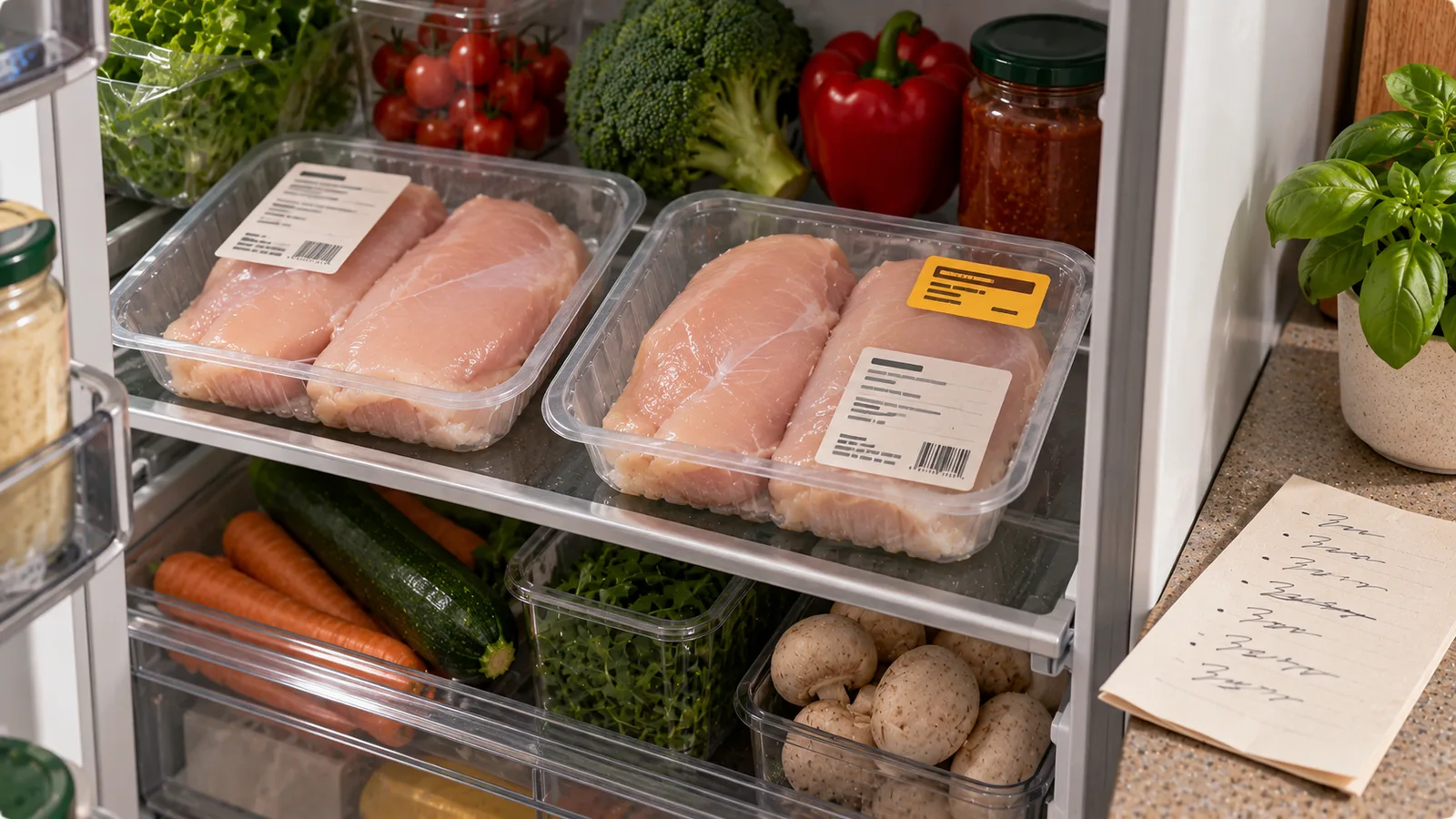
A supermarket discount sticker can make a product look like an obvious bargain. A pack of chicken reduced by 40%, a bag of spinach marked down to half price or a bakery item offered for a fraction of its original cost can all appear to save money.
But the discount percentage is only part of the calculation.
A reduced-to-clear product is a good deal when you can use it safely, when its usable quantity is worth the price and when buying it actually reduces what you would otherwise spend.
If half the food ends up in the bin, the advertised saving may disappear.
What does reduced-to-clear mean?
Reduced-to-clear foods are products that retailers discount to sell quickly.
Common reasons include:
- A use-by or best-before date is approaching.
- The shop has more stock than expected.
- Packaging is changing.
- A product is being discontinued.
- Fresh produce is cosmetically imperfect.
- A bakery or prepared-food counter is closing for the day.
These situations are not identical.
A sealed, refrigerated product approaching its use-by date requires different decisions from a slightly bruised apple or a discontinued shelf-stable product.
The first question should not be how large the discount is. It should be whether you can realistically use the food.
The three numbers that determine the real value
Before buying a discounted product, check:
- The reduced price.
- The amount you expect to eat.
- The price of a realistic alternative.
A 50% discount is not necessarily better than a 20% discount if much of the first product will be wasted.
Calculate the effective price of edible food
A useful formula is:
Effective cost per kilogram eaten = price paid ÷ kilograms actually eaten.
Suppose a 1 kg bag of vegetables costs €2.00 after a markdown.
You use 600 g and discard 400 g.
Your effective cost becomes:
€2.00 ÷ 0.6 kg = €3.33 per kg eaten.
Now compare that with a fresh 1 kg bag priced at €2.80 that you expect to finish.
The full-price bag costs €2.80 per kg eaten.
Despite the discount sticker, the reduced bag is more expensive for your actual use.
This is a comparison of purchase cost against food consumed. It does not include cooking energy, transport or preparation time.
Five realistic supermarket examples
| Product | Original price | Reduced price | Expected use | Effective result |
|---|---|---|---|---|
| 500 g mushrooms | €2.49 | €1.25 | All 500 g | €2.50/kg eaten |
| 1 kg salad mix | €4.00 | €2.00 | 400 g | €5.00/kg eaten |
| 400 g tofu | €3.00 | €2.10 | All 400 g | €5.25/kg eaten |
| 750 g strawberries | €4.50 | €2.25 | 500 g | €4.50/kg eaten |
| 1 kg potatoes | €2.20 | €1.65 | All 1 kg | €1.65/kg eaten |
These prices are hypothetical examples, not current supermarket quotations.
The table illustrates why the portion you actually use matters more than the markdown percentage alone.
Example: mushrooms for tonight's dinner
You planned to make mushroom pasta and need 500 g.
The store offers a 500 g pack for €1.25 instead of €2.49.
The mushrooms are in acceptable condition and can be cooked today.
If you would otherwise have bought the full-price pack, the saving is:
€2.49 − €1.25 = €1.24.
That is a genuine saving because the discounted product replaces an intended purchase.
Example: discounted salad you did not plan to buy
You buy a large bag of salad because it is half price.
You eat less than half before the rest deteriorates.
You also continue buying the vegetables already planned for the week.
The discounted salad may have increased your total spending rather than reduced it.
The purchase created an additional expense instead of replacing one.
Use-by versus best-before: the essential distinction
In the EU, date labels do not all have the same meaning.
Use-by date
A use-by date concerns food safety.
It appears on highly perishable foods where microbiological risks may develop.
Do not eat food after its use-by date, even if it looks and smells normal.
For a reduced-to-clear product approaching this date, decide whether you can use it before the deadline or freeze it appropriately before the date, following the product's instructions.
Cooking food after its use-by date is not a reliable way to make it safe.
Best-before date
A best-before date primarily concerns quality.
Food may remain suitable after that date if it has been stored correctly and the packaging is intact, but its taste, texture or other quality characteristics may decline.
Assess the product appropriately and follow any storage instructions.
A best-before date is not permission to ignore signs of spoilage or damaged packaging.
The difference in practice
| Label | Main purpose | Buying decision |
|---|---|---|
| Use by | Food safety | Plan to consume or appropriately freeze before the date |
| Best before | Food quality | Consider storage, packaging and product condition |
| No date on some fresh produce | Product-specific rules | Inspect freshness and realistic storage life |
For EU rules, see Regulation (EU) No 1169/2011.
When reduced-to-clear foods are usually worth considering
You already planned to buy the ingredient
This is one of the strongest situations for a genuine saving.
If you need broccoli for dinner and find a suitable discounted pack, the markdown directly reduces an existing expense.
You do not need to invent a new recipe or increase the amount of food in your kitchen.
You can cook the food promptly
A discounted ingredient may be excellent value when you can use it the same day.
Examples include:
- Vegetables for soup.
- Mushrooms for a pasta sauce.
- Ripe fruit for a dessert.
- Bread for dinner.
- A suitable refrigerated ingredient for a meal already scheduled.
You have freezer space and a safe plan
Freezing can extend the practical usefulness of some foods.
However, it is not a universal solution.
Check whether the product is suitable for freezing, follow package instructions and freeze before a use-by date where applicable.
Freezing does not reverse spoilage or make food that was already unsafe safe again.
The discount applies to a product you buy regularly
If a shelf-stable staple is genuinely cheaper than your normal option, the purchase may be worthwhile even when you do not need it immediately.
Check storage space, package condition and the actual unit price.
When a discount is probably not a saving
A markdown is less attractive when:
- You do not have a realistic meal planned.
- The package is much larger than you need.
- The product requires extra ingredients you would not otherwise buy.
- You cannot store it appropriately.
- You already have enough similar food at home.
- A cheaper alternative is available at its regular price.
- The food is close to a use-by date and you cannot consume or safely freeze it in time.
The largest percentage discount is not necessarily the best purchase.
Compare the reduced price with the cheapest suitable alternative
Retailers often display discounts relative to the product's previous price.
But your relevant comparison may be a different product.
Suppose:
- Premium yogurt: €2.40, reduced to €1.68.
- Comparable store-brand yogurt: €1.45 at regular price.
The premium yogurt has a 30% markdown but still costs €0.23 more.
If both products meet your needs, the discounted premium product is not the lowest-cost option.
This does not mean it is always a bad purchase. You may prefer its taste, ingredients or package size.
It means the discount percentage and the cheapest acceptable price are different questions.
A quick calculation before putting it in your basket
Use this decision sequence:
- Would I buy this food without the discount?
- If not, does it replace something already in my meal plan?
- Can I use the full edible portion safely?
- What is the reduced price per kilogram or litre?
- What is the cost per portion I will actually eat?
- Is there a cheaper suitable alternative?
If the answers are unclear, leaving the product on the shelf may be the better financial decision.
Example: a reduced 600 g pack of vegetables
The pack costs €1.80 instead of €3.00.
You expect to use 450 g.
Effective price:
€1.80 ÷ 0.45 kg = €4.00/kg eaten.
A different fresh vegetable costs €3.20/kg, and you expect to use all of it.
The fresh alternative is cheaper per edible kilogram.
If the discounted vegetables fit a specific recipe better, that may still justify the choice, but the calculation makes the trade-off visible.
How much can reduced-to-clear shopping save in a month?
The meaningful number is the difference between what you actually paid and what you would otherwise have paid for the food you used.
Suppose you make eight successful substitutions in a month:
| Purchase | Normal alternative | Reduced purchase | Saving |
|---|---|---|---|
| Vegetables for soup | €3.20 | €2.00 | €1.20 |
| Bread | €2.50 | €1.50 | €1.00 |
| Tofu | €3.00 | €2.10 | €0.90 |
| Mushrooms | €2.49 | €1.25 | €1.24 |
| Fruit for breakfast | €3.50 | €2.40 | €1.10 |
| Yogurt alternative | €2.20 | €1.50 | €0.70 |
| Potatoes | €2.20 | €1.65 | €0.55 |
| Vegetables for curry | €3.00 | €1.80 | €1.20 |
| Total | €22.09 | €15.20 | €6.89 |
These are illustrative prices.
The €6.89 saving only applies if all eight discounted purchases replaced comparable planned purchases and were used.
If you also bought €9 worth of unnecessary discounted food that was not consumed, your overall shopping expenditure would have increased.
Reduced produce: inspect the edible portion
A reduced bag of produce may include some bruised or damaged pieces.
The important distinction is between minor cosmetic imperfections and spoilage.
A slightly imperfect vegetable may still be usable after appropriate preparation.
Food showing significant decay or mould should not be treated as a bargain merely because the price is low.
Do not assume that removing a visibly affected section always makes mouldy food safe.
The correct action depends on the type of food and extent of contamination.
When in doubt about safety, do not buy or consume the product.
Reduced meat, fish and chilled foods
These products require particularly careful attention to time and temperature.
Before purchasing:
- Check the use-by date.
- Confirm the packaging is intact.
- Make sure the product has been properly refrigerated.
- Plan when it will be cooked or frozen.
- Follow the storage and cooking instructions.
A large markdown does not compensate for an inability to store or prepare the product safely.
Do not rely on smell alone to judge the safety of food approaching or past a use-by date.
Bakery markdowns and end-of-day offers
Bread and bakery products are common reduced-to-clear purchases.
They can be useful if you already need bread or can freeze a suitable product promptly.
But buying several pastries because they are cheap can increase spending if they were not part of your intended purchases.
Compare the actual amount you will eat.
A three-item bundle is not automatically cheaper for your needs than buying one fresh item.
Discounted prepared meals
Ready meals require a slightly different calculation.
Compare:
- The reduced purchase price.
- The actual serving size.
- Any additional side dishes needed.
- Storage and use-by requirements.
- The cost of a realistic alternative meal.
A discounted ready meal may be convenient and economical when it replaces another meal.
It may be poor value if the portion is too small and you need to buy substantial extras.
How to track markdown savings without complicated spreadsheets
A simple record can help you see whether discount shopping works.
For each relevant purchase, note:
| Field | Example |
|---|---|
| Product | Mushrooms, 500 g |
| Normal alternative price | €2.49 |
| Reduced price | €1.25 |
| Amount eaten | 500 g |
| Amount discarded | 0 g |
| Actual saving | €1.24 |
Only count a saving when the purchase replaces something you would otherwise have bought.
For an impulse purchase, record its cost as additional spending rather than assuming the difference from the original shelf price is money saved.
A simple weekly review
At the end of the week, ask:
- Which reduced products did I finish?
- Which products spoiled?
- Did I spend more on extra ingredients?
- Did the discounts replace planned purchases?
- Which types of markdowns consistently worked?
After several weeks, you may discover that reduced bread and vegetables are useful for your routine while large bags of salad are not.
That is more valuable than chasing the highest discount percentage.
A practical rule for deciding
Reduced-to-clear food is usually worth buying when three conditions are met:
It is safe to use, it replaces a real need, and its effective cost is lower than the suitable alternative.
A discount sticker is an invitation to compare, not proof of a saving.
The best grocery bargain is food you actually eat at a lower total cost.